How to Start a Cattery Business in 2026
The licence, the building standards your pens must meet, what catteries charge per night, and the numbers behind a cattery business, with notes for the US, Canada and Australia.
This site is published by the team behind Pupline, our top pick. Who we are
To start a cattery in England, you need planning permission for the site, a licence from your local council under the Animal Welfare (Licensing of Activities Involving Animals) (England) Regulations 2018, and pens built to Defra's cat boarding standards: at least 0.85 m² of sleeping area and 1.65 m² of exercise run per cat, 1.8 metres high, with sneeze barriers between units. Add insurance, a pricing plan that works at realistic occupancy, and a booking and records system, and you have the core of a cattery business. This guide covers each step, with the actual rules and real prices, plus notes for the US, Canada and Australia.
Step 1: Check the market
Before you build, find out whether local catteries are full. Ring every cattery within about 20 minutes as a customer and ask about availability in August and at Christmas. If they are booked out months ahead, there is demand you can capture. If they have plenty of space, you will need a clear reason for cat owners to choose you.
Note their prices, unit types (walk-in units, penthouse pods), extras and review scores. Many catteries differentiate on things cat owners care about: quiet locations away from dogs, heated sleeping areas, views from the run, and small numbers of cats.
Step 2: Understand the licence (England)
Providing boarding for cats is a licensable activity in England. You apply to your district or unitary council, an inspector visits, and the council issues a licence with a star rating from 1 to 5. The inspector checks your premises and procedures against Defra's cat boarding statutory guidance, last updated on 1 June 2026.
According to that guidance, a 4 or 5 star rating requires meeting 100% of the required higher standards and at least 50% of the optional ones, and businesses that meet the higher standards can receive a 2 or 3 year licence instead of a 1 year licence. A longer licence means fewer inspection fees, and a higher star rating is a selling point with customers.
Fees vary widely by council. Buckinghamshire charges £666 for providing boarding for cats from 1 April 2026. Hart District Council charges £318 for boarding businesses with fewer than 20 animals in 2026/27, and notes that vet fees, where needed, must be paid before a licence is granted.
You will also need planning permission for a new cattery building or a change of use, which is a separate application to your local planning authority. Talk to the planning team early: noise is rarely an issue with cats, but access, parking and the building itself may be.
Scotland, Wales and Northern Ireland have their own licensing rules, so check with your local authority. Our UK dog boarding licence guide explains the star rating system in more detail, and it works the same way for catteries.
Step 3: Design and build to the standards
This is where a cattery differs most from a kennel. Defra's guidance sets out minimum sizes for new builds:
| Unit part | 1 cat | Up to 2 cats | Up to 4 cats |
|---|---|---|---|
| Walk-in sleeping area | 0.85 m² (min 0.9 m dimension) | 1.5 m² (min 1.2 m) | 1.9 m² |
| Penthouse pod sleeping area | 0.85 m² | 1.1 m² | 1.7 m² |
| Exercise run | 1.65 m² | 2.2 m² | 2.8 m² |
| Minimum height | 1.8 m for units and runs; 1 m for penthouse pods | Same | Same |
Other key building standards from the same guidance:
- Sneeze barriers. Adjoining units need solid barriers covering the full height and width of the shared wall. Where units are separated by a gap instead, it must be at least 0.6 m wide, and corridors between facing units must be at least 1.2 m wide. New builds need at least translucent barriers; the higher standard requires fully opaque ones.
- Temperature. "The insulation and temperature must keep some part of the sleeping area between 15°C and 26°C," and "the temperature must never go below 10°C." The higher standard is 18°C to 26°C. Heated beds can supplement but not replace heating, and cats must be able to move away from the heat.
- Elevated areas. Every unit needs a raised area. The higher standard asks for at least two per cat, one in the sleeping area and one in the run.
- Litter trays. At least 30 cm by 42 cm and 3 cm deep, with food and water kept at least 60 cm away. Scented litter, loose sawdust, shredded or sheet newspaper and soil are not acceptable.
- Isolation. You must be able to isolate sick, injured or infectious cats, and a cat isolated for more than 12 hours needs a unit of normal size.
- Sharing. Only cats from the same household may share a unit.
Older catteries built to earlier standards may keep smaller units, but new builds must meet the dimensions above. If you plan to aim for 4 or 5 stars, design to the higher standard from the start: enlarging units later is far more expensive than building them big.
Some cattery guides refer to standards from International Cat Care, the cat welfare charity. We could not find a current cattery standards document on its website as of November 2026, so Defra's guidance is the standard to build to in England.
Get quotes from specialist cattery builders and a general builder, and ask each to confirm in writing that the design meets Defra's guidance. Ask your council's licensing officer to review the plans before you build, since some will.
Step 4: Staffing and daily care
Defra's guidance says "each member of staff should have 25 cats or less to care for." The required higher standard is "at least one full time member of staff for every 20 cats, or a higher number of qualified staff."
Staff need a formal qualification such as an Ofqual-regulated Level 2, or must show relevant knowledge and experience. You need a written training policy, reviewed every year.
Daily care rules include:
- Cats visited at regular intervals no more than 3 hours apart between 8am and 6pm.
- At least one out-of-hours check under the higher standard, by a person or by CCTV.
- Cats staying longer than three weeks checked for weight loss or gain.
- A competent person on site at all times to meet the higher standard for emergencies.
That last point shapes the business: running the cattery from a home on the same site is one practical way to meet it.
Step 5: Records, vaccinations and policies
Defra requires a cat register with arrival and departure dates, owner and emergency contacts, the vet and insurance details, medical and behaviour history, diet, consent forms, and vaccination, worming and flea treatment dates. Records must be kept for at least 3 years, be available for inspection, and electronic records must be backed up.
Cats must be currently vaccinated against feline panleukopenia (feline infectious enteritis) and the feline respiratory viruses (feline herpesvirus and feline calicivirus). A vet's titre test can replace a booster if the certificate says it is valid for the current period. In practice, some catteries ask for vaccinations completed at least two weeks before admission; the RSPCA Solent Branch cattery, for example, requires this along with worming within six months and regular flea treatment.
Your booking terms should cover deposits, cancellations, peak dates, vet authorisation, what you need to see on arrival and what happens if a cat falls ill. Our dog boarding contract template can be adapted for cats.
Step 6: Set your prices
Cattery prices are much lower than kennel prices, so the business depends on volume and occupancy.
| Where | Price per cat per night | Source and date |
|---|---|---|
| UK average | £15.01 | TrustedHousesitters research, January 2025 |
| Hampshire (RSPCA Solent) | £12, rising to £13.20 for stays from April 2027 | RSPCA Solent Branch, 2026 |
| Hertfordshire (Country Boarding) | £21.50 single cat; £17.50 + £12 for two sharing | 2025 price list |
| US average | $26.50 average, $25 median | Goose, 2026 |
| Denver, US (pet resort) | $45, $62 or $72; extra cat $7 | Overland Animal Hospital, 2026 |
| Texas, US (pet resort) | $44 Kitty Condo | The Palms Pet Resort |
| Australia average | A$37.90 | TrustedHousesitters research, January 2025 |
| Australia (range) | A$20 to A$40 standard, up to A$100+ luxury | Hanrob, August 2026 |
| Victoria, Australia | A$23.50 to A$34; +A$5 public holidays | Animal Aid, July 2026 |
We did not find reliable published cattery prices for Canada, so check local catteries directly.
A few patterns stand out:
- Second cat discounts are steep. Country Boarding charged £12 for a second cat sharing against £17.50 for the first, and Overland charges just $7 for an extra cat.
- Bank holidays carry surcharges. Country Boarding added £14 a night for the first cat on bank holidays in 2025, and Animal Aid adds A$5 on public holidays.
- Food may be extra. Country Boarding charged £1.30 a night for cattery food in 2025.
- Charities and rescues often charge less, so price against private catteries rather than a rescue cattery.
Step 7: Do the revenue math
Here is an illustration for a 20-unit cattery in England. The figures are assumptions to show the method, not data.
- 20 units x 365 nights = 7,300 unit-nights available.
- At 60% occupancy across the year: 4,380 unit-nights sold.
- Average revenue per unit-night £22, including second cats sharing, peak surcharges and extras.
- Annual revenue: 4,380 x £22 = £96,360.
Now take off the costs: staff, heating (the 15°C minimum makes winter heating a real cost), cleaning, food, litter, insurance, licence, software, marketing and repairs. If the cattery is run by the owners from an on-site home, wages may be low, which is how many small catteries stay profitable. If you need to employ staff for every shift, the numbers get tight quickly.
Cattery demand is strongly seasonal, peaking in summer and at Christmas. Take deposits for peak dates, and consider minimum stays over Christmas. Our dog boarding business plan guide has a full outline and scenario method that works for catteries too, and our dog boarding prices guide covers holiday surcharge structures.
Step 8: Insurance
You need public liability and cover for the cats in your care (often called care, custody and control, or animal bailee cover), plus buildings and contents cover and employers' liability once you hire staff. For a US benchmark, Insureon's figures for pet boarding businesses put general liability at about $53 a month and a business owner's policy at about $92, based on the median of policies bought through Insureon. Get several quotes from insurers that cover boarding businesses specifically.
Starting a cattery outside the UK
United States
There is no national cattery licence. Boarding is usually covered by state or local kennel and pet facility licences, plus zoning. Colorado, for example, licenses pet animal care facilities under its Pet Animal Care Facilities Act. Ask your state agriculture department and your county or city planning office what applies, and whether rules written for dog kennels also cover cats. Cat boarding in the US is often sold alongside dog boarding, as at the Denver and Texas pet resorts in the price table above, so a cats-only building away from dog noise can be a selling point.
Canada
Rules are mainly municipal and provincial. Contact your city's animal services and planning department. Where no local construction standard exists, you can use established guidance such as Defra's unit sizes as a benchmark and tell customers you build to it.
Australia
In Victoria, boarding establishments for dogs and cats must register with their council as a Domestic Animal Business and follow the Code of Practice for the Operation of Boarding Establishments, which sets minimum standards of accommodation, management and care. Other states have their own codes and council requirements, so check with your council before you buy land or build.
Step 9: Choose software
A cattery's paperwork is heavier than it looks: vaccination dates for every cat, consent forms, diet and medication notes, and a record of every stay kept for three years in England. On paper, that is a filing cabinet and a risk at inspection time.
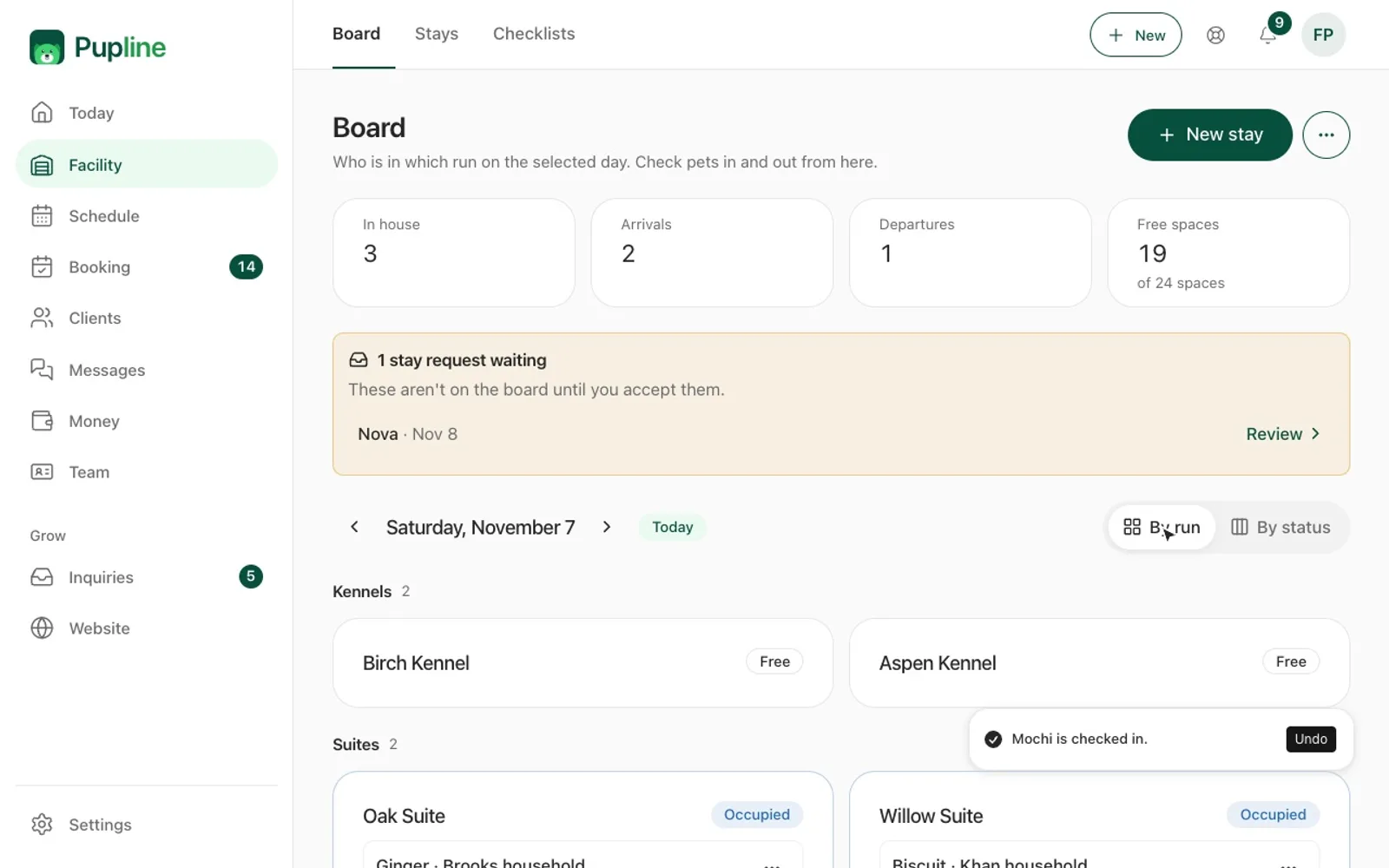
Pupline, made by the team behind this site, supports catteries alongside kennels and daycares. It includes named runs, suites and rooms with capacities, an occupancy board, online booking requests where owners pick dates and a unit with space without needing a login, per-night billing with peak rates and extras, vaccination tracking with warnings before vaccines lapse, e-signed agreements, Care Cards that owners fill in before a stay, and photo report cards that reassure owners while they are away. The Small plan is $99 a month for up to 25 pet spaces, with a 30-day free trial and no card needed. See the best cattery software for a wider comparison, including UK-focused options.
Cattery startup checklist
How to start a cattery: checklist
Free to copy and adapt. Use your browser's Print to save as PDF.Research
- Local catteries listed, with prices, unit types and peak availability
- Business plan with occupancy scenarios (low, expected, high)
Permissions
- Planning permission or change of use confirmed
- Licence application to the council (England), or local equivalent
- Plans reviewed against Defra guidance (or local rules) before building
Building
- Units at or above minimum sizes; higher standard if aiming for 4 or 5 stars
- Sneeze barriers or 0.6 m gaps; 1.2 m corridors between facing units
- Heating to keep sleeping areas at 15°C to 26°C (18°C to 26°C for higher standard)
- Raised shelves in every unit
- Isolation unit
- Food preparation, laundry and storage areas
People and care
- Staff ratio planned (25 cats per person, 20 for higher standard)
- Qualifications or documented experience; written training policy
- Check schedule (at least every 3 hours, 8am to 6pm)
- Someone competent on site at all times
Records and policies
- Cat register fields and 3-year record retention
- Vaccination policy and titre test policy
- Booking terms, deposits, cancellations and vet authorisation
Business
- Price list with second-cat and peak rates
- Insurance quotes
- Software set up with units, rates and booking
- Website and Google Business Profile
Do I need a licence to run a cattery?
In England, yes. Providing boarding for cats is licensable under the Animal Welfare (Licensing of Activities Involving Animals) (England) Regulations 2018. You apply to your local council, which inspects against Defra's cat boarding guidance and gives a star rating. Fees vary by council, for example £318 at Hart and £666 at Buckinghamshire in 2026.
What size does a cattery pen need to be?
Defra's guidance for England sets a minimum of 0.85 square metres of sleeping area and 1.65 square metres of exercise run for one cat, with units and runs at least 1.8 metres high. Units for two or four cats from the same household are larger. Higher-standard units must be 1.5 times the minimum areas.
How much do catteries charge per night?
TrustedHousesitters research put the UK average at £15.01 a night in early 2025, with some private catteries charging over £20. Goose's 2026 data found an average US cat boarding rate of $26.50, and Australian catteries averaged about A$37.90. Second cats sharing a unit are usually much cheaper.
Can I run a cattery from home?
Some small catteries are run from the owner's home, which also helps meet the requirement in England's higher standards for a competent person to be on site at all times. You still need planning permission for the cattery buildings and a council licence, and the units must meet Defra's size and design standards.
How many cats can one person look after in a cattery?
Defra's guidance for England says each member of staff should care for 25 cats or fewer. To meet the higher standard, there must be at least one full-time staff member for every 20 cats, or a higher number of qualified staff.
What vaccinations do cats need for a cattery?
In England, Defra's guidance requires current vaccination against feline panleukopenia, also called feline infectious enteritis, and the feline respiratory viruses that cause cat flu. A vet's titre test can replace a booster if the certificate confirms it is valid. Many catteries also require worming and flea treatment.
Sources
- Defra: cat boarding licensing statutory guidance for local authorities (updated June 2026)
- Buckinghamshire Council: animal licence fees (from April 2026)
- Hart District Council: animal licence fees 2026/27
- TrustedHousesitters UK pet care prices, reported by Travelling for Business (January 2025)
- RSPCA Solent Branch: cat boarding
- Country Boarding for Cats and Dogs 2025 price list
- Goose: pet boarding prices research (2026)
- Overland Animal Hospital pet resort rates (2026)
- The Palms Pet Resort and Spa pricing
- TrustedHousesitters Australia pet care prices, reported by Pet News (January 2025)
- Hanrob: how much does pet boarding cost in Australia (August 2026)
- Animal Aid boarding rates (July 2026)
- Business.gov.au: Victorian Code of Practice for the Operation of Boarding Establishments
- Insureon: pet boarding insurance cost (updated July 2025)
Keep reading
- GuidesDog Boarding Business Plan: A Full Outline With a Worked Example
- GuidesDog Boarding Contract Template and Dog Daycare Waiver
- GuidesDog Boarding Invoice Template: Free to Copy, With Tax Notes
- GuidesDog Boarding Licence UK: The Complete 2026 Guide
- GuidesDog Boarding Prices in 2026: What a Night Really Costs
- GuidesDog Daycare Intake Form: Free New Client Template