Dog Boarding Contract Template and Dog Daycare Waiver
A plain-English boarding agreement and daycare waiver you can copy and adapt, with notes on every clause and the regional differences that matter.
This site is published by the team behind Pupline, our top pick. Who we are
A dog boarding contract template gives you a written agreement that sets out what you will do for a dog, what the owner must tell you and pay, and who is responsible when something goes wrong. Below you will find a full boarding agreement and a shorter dog daycare waiver you can copy, plus a clause-by-clause explanation so you can adapt them instead of signing something you do not understand.
One caveat before you copy anything: this is a starting template, not legal advice. Contract and liability law differs between US states, Canadian provinces, Australian states and the UK nations, and a clause that holds up in one place can be unenforceable in another. Have a local lawyer review your final version before you use it with clients.
Why every boarding business needs a written agreement
Most disputes in boarding come down to expectations that were never written down. An owner assumes you will give their dog a tablet twice a day, you assumed once. An owner books a 10-day stay, cancels the day before, and is surprised to lose the deposit. A dog picks up a cough in group play, and the owner expects you to pay the vet bill.
A written dog boarding agreement does not stop these things happening, but it makes the answer clear before anyone is upset. It also proves that the owner told you about medical conditions and behavior, which matters if a dog bites a member of staff or another dog. For licensed businesses in England, written consent forms are part of the record inspectors expect to see, as we explain in our UK dog boarding licence guide.
What a dog boarding agreement should cover
These are the sections most boarding agreements need. The template further down includes all of them.
Parties, pets and dates
Name the business (with its legal name and license number if you have one), the owner, every dog by name, breed, age and microchip number, and the booked dates and times. List each dog separately, because medical and behavior clauses apply dog by dog.
Services and pricing
State what the price includes: the nightly or daily rate, feeding, walks or play, and any extras such as baths, medication administration or one-to-one time. Say how peak and holiday dates are priced, whether there is a minimum stay, and whether the price is per dog or per run. If you need a reference point, our dog boarding prices guide covers typical rates in the US, UK, Canada and Australia.
Deposits, payment and cancellations
This is the clause owners argue about most, so be specific. Say how much deposit you take, when the balance is due, and what happens to the deposit at different notice periods. A common structure is a full refund or credit with plenty of notice, a partial refund closer to the date, and no refund inside a short window or at peak times. Whatever you choose, make it proportionate. In the UK, an unfair term in a consumer contract "is not binding on the consumer" under section 62 of the Consumer Rights Act 2015, and a term is unfair if it causes "a significant imbalance in the parties' rights and obligations" to the consumer's detriment. A cancellation fee that bears no relation to your real loss is the kind of term that can fail that test.
Vaccinations and health
Set out the vaccines you require, how proof must be provided, and that you can refuse entry if records are missing or out of date. Common requirements are rabies (in the US and Canada), the distemper, hepatitis and parvovirus combination (DHPP or DAPP), and Bordetella, plus leptospirosis, which licence conditions in England require. Our dog daycare intake form guide explains each one with sources. Also require the owner to disclose medical conditions, medications, allergies and recent illness, and to confirm flea and worm treatment.
Emergency veterinary care
You need written permission to get a dog treated if it falls ill or is injured while you have it, plus the owner's vet details and a spending limit before you must call them. Say who pays for emergency treatment and how quickly it must be repaid. Ask whether the dog is insured and record the policy details.
Behavior and temperament
The owner should confirm the dog's history of aggression, bites, resource guarding, escape attempts and separation anxiety. Reserve the right to separate a dog from the group, end a stay early or refuse future bookings for safety reasons, and to charge for extra care if needed. State that owners are responsible for damage or injury their dog causes where they failed to disclose known behavior.
Group play and the risks you cannot remove
Dogs that play together can get scrapes, bites, strains and contagious illnesses, even with good supervision and full vaccinations. The agreement should explain those risks in plain words and record that the owner accepts them. Be careful not to overreach. In the UK, section 65 of the Consumer Rights Act 2015 says a trader cannot exclude or restrict liability "for death or personal injury resulting from negligence", which applies to people, such as an owner bitten at collection. More broadly, in most places you cannot contract out of responsibility for your own negligence towards a dog in your care either, so a waiver should explain inherent risks rather than claim you are never responsible.
Collection, late pickup and abandonment
Say who may collect the dog, how identity is checked, your opening hours for drop-off and pickup, and the fee for late collection. Include an abandonment clause: if a dog is not collected within a set number of days after the booked end date and the owner cannot be reached, what you will do. Your lawyer should check this one carefully, because the steps you can lawfully take with an abandoned animal vary by state, province and country.
Photos, records and data
Ask permission to share photos and videos on social media, and say how you store the owner's personal data. In the UK and EU, data protection law applies to client records, so keep the privacy notice short and accurate.
Consents required by UK licensing
If you are licensed in England, the Defra guidance requires specific written consents. The home boarding guidance asks for written consent from every owner before dogs from different households are boarded together, and owner consent to walk a dog outside the home, let it off the lead, or walk it with dogs from other households. The day care guidance asks for owner consent before crating, before group walks, and before dogs under one year old mix with older dogs. The template includes tick boxes for these.
Dog boarding agreement template
Copy the template below into your word processor or booking system and replace everything in square brackets. Delete clauses that do not apply, such as the UK consents if you operate elsewhere.
Dog boarding agreement
Free to copy and adapt. Use your browser's Print to save as PDF.[Business legal name] trading as [Trading name]
Address: [Address] | Phone: [Phone] | Email: [Email]
License or permit number (if applicable): [Number]
Section 1: Owner details
- Owner name: [Name]
- Address: [Address]
- Mobile and email: [Mobile], [Email]
- Emergency contact (not travelling with the owner): [Name, relationship, phone]
- Authorised to collect: [Names]
Section 2: Dog details (repeat for each dog)
- Name, breed, sex, neutered or spayed: [Details]
- Date of birth: [Date] | Microchip number: [Number]
- Usual vet: [Practice name, phone]
- Pet insurance: [Insurer, policy number] or none
Section 3: Booking
- Arrival: [Date, time] | Departure: [Date, time]
- Accommodation: [Run, suite or room type]
- Services and extras: [List]
- Price: [Nightly or daily rate] x [Nights] + [Extras] = [Total]
- Deposit paid: [Amount] on [Date] | Balance due: [Date or at collection]
Section 4: Payment and cancellation
- 4.1 A deposit of [amount or percentage] secures the booking.
- 4.2 The balance is due [at drop-off or at collection].
- 4.3 If the owner cancels at least [X] days before arrival, the deposit is [refunded or credited to a future stay].
- 4.4 If the owner cancels less than [X] days before arrival, [describe what is kept].
- 4.5 Bookings over [peak dates] are subject to [peak cancellation terms].
- 4.6 Early collection does not reduce the booked price unless agreed in writing.
- 4.7 If we cancel, the owner receives a full refund of all money paid.
Section 5: Health and vaccinations
- 5.1 The owner confirms the dog is in good health and has not shown signs of infectious illness in the last [14] days.
- 5.2 The dog is vaccinated against [rabies, distemper, hepatitis, parvovirus, Bordetella, leptospirosis, other], with proof provided before arrival.
- 5.3 Primary vaccination courses were completed at least [14] days before arrival.
- 5.4 The dog has been treated for fleas and worms within [period].
- 5.5 We may refuse admission if vaccination proof is missing or the dog appears unwell on arrival.
- 5.6 Medical conditions, medications (name, dose, timing) and allergies: [Details]
Section 6: Emergency veterinary care
- 6.1 If the dog needs veterinary attention, we will try to contact the owner and the emergency contact.
- 6.2 If we cannot reach them, the owner authorises us to obtain treatment from [the dog's usual vet or our nominated vet] up to [amount] without further consent.
- 6.3 Above that amount, we will only authorise treatment needed to relieve suffering or save the dog's life.
- 6.4 The owner will pay all veterinary costs and reasonable transport costs within [X] days of being invoiced.
Section 7: Behavior
- 7.1 The owner confirms the dog [has or has not] bitten, attacked or shown aggression to people or other dogs. Details: [Details]
- 7.2 Other relevant behavior (guarding, escaping, anxiety, reactivity): [Details]
- 7.3 We may separate the dog from other dogs, change its routine or end the stay early if we believe it is necessary for safety, and the owner will collect the dog or arrange collection within [X] hours.
- 7.4 The owner is responsible for loss or injury caused by the dog where known behavior was not disclosed.
Section 8: Care and group activities
- 8.1 We will provide food, fresh water, shelter, exercise and care in line with [our license conditions or published standards].
- 8.2 The owner understands that dogs who play or exercise together can suffer minor injuries or catch illnesses despite good supervision and vaccination.
- 8.3 Group play: [ ] Yes [ ] No
Section 9: Written consents (UK licensed businesses, tick to agree)
- Walk my dog outside the premises
- Let my dog off the lead in a secure area
- Walk my dog with dogs from other households
- Board my dog with dogs from other households
- Use a crate as part of my dog's normal routine
- My dog is under one year old and may mix with older dogs
Section 10: Food and belongings
- 10.1 Food: [Provided by owner or by us] | Feeding times and amounts: [Details]
- 10.2 We will take reasonable care of belongings but are not responsible for normal wear or damage to toys and bedding.
Section 11: Collection and abandonment
- 11.1 Collection is during opening hours only: [Hours]. Late collection is charged at [rate].
- 11.2 We will only release the dog to the owner or a named authorised person on production of [ID].
- 11.3 If the dog is not collected within [X] days of the booked departure date and we cannot contact the owner or emergency contact, we may [action agreed with your lawyer, in line with local law], and the owner remains liable for all fees.
Section 12: Photos and data
- 12.1 We may share photos or videos of the dog on social media: [ ] Yes [ ] No
- 12.2 We store the information in this agreement to provide our services and meet legal record keeping duties, as described in our privacy notice: [Link]
Section 13: Liability
- 13.1 We will take reasonable care of the dog at all times.
- 13.2 Nothing in this agreement limits our liability for our own negligence where the law does not allow it to be limited.
- 13.3 [Any further limitation your lawyer approves for your jurisdiction.]
Section 14: Signatures
Owner signature: [Signature] | Date: [Date]
For the business: [Name, signature] | Date: [Date]
Dog daycare waiver template
A daycare waiver is shorter than a boarding agreement, because there is no overnight stay, no long-term medication plan and usually no deposit. It focuses on the temperament assessment, group play risks and emergency care. Ask for it once when the dog joins, then again each year or when your terms change.
Dog daycare waiver and release
Free to copy and adapt. Use your browser's Print to save as PDF.[Business name] dog daycare enrollment and waiver
- Owner: [Name] | Phone: [Phone] | Email: [Email]
- Dog: [Name, breed, age, sex, neutered or spayed]
- Emergency contact: [Name, phone]
- Usual vet: [Practice, phone]
Section 1: Temperament assessment
- 1.1 My dog must pass a temperament assessment before joining group play.
- 1.2 [Business name] may move my dog to a different group, give it rest time alone or end its enrollment if it shows behavior that puts other dogs or staff at risk.
Section 2: Vaccinations and health
- 2.1 My dog is up to date on [rabies, DHPP or DAPP, Bordetella, other] and I will provide proof before each renewal date.
- 2.2 I will keep my dog at home if it shows signs of illness, including coughing, vomiting or diarrhea, and for [X] days after recovery.
- 2.3 My dog is protected against fleas and ticks.
Section 3: Understanding group play
- 3.1 I understand that dogs who play together in groups can get scratches, nicks, bruises, strains and occasional bites, even with trained staff supervising.
- 3.2 I understand that contagious illnesses such as kennel cough can spread between dogs, including vaccinated dogs.
- 3.3 I accept these inherent risks of group play for my dog.
Section 4: Emergency care
- 4.1 If my dog needs urgent care and I cannot be reached, I authorise [Business name] to take my dog to [my vet or the nearest emergency vet] and approve treatment up to [amount].
- 4.2 I will pay for that treatment and related costs.
Section 5: Owner responsibilities
- 5.1 I have told [Business name] about any history of aggression, bites, escape attempts or medical conditions.
- 5.2 I am responsible for injury or damage my dog causes where I did not disclose known behavior.
Section 6: Payment and cancellations
- 6.1 Daycare is charged at [rate or package]. Unused package days expire [period].
- 6.2 Same-day cancellations are charged at [rate].
Section 7: Photos
- I agree to photos and videos of my dog being shared on social media: [ ] Yes [ ] No
Section 8: Release
- 8.1 [Wording approved by your lawyer for your jurisdiction.]
- 8.2 Nothing in this waiver limits liability for negligence where the law does not allow it to be limited.
Owner signature: [Signature] | Date: [Date]
Regional notes before you use these templates
Use these points as questions for your lawyer, not answers.
- United States. The enforceability of liability waivers is a matter of state law and courts treat them differently, so the release wording in clause 8 is the part most worth paying for. Also ask about your state's rules on abandoned animals and any state or local kennel standards you must reference. Our guide to dog daycare license requirements lists examples of state rules.
- United Kingdom. Consumer contracts must be fair under the Consumer Rights Act 2015, and you cannot exclude liability for death or personal injury caused by negligence. Licensed businesses in England also need the written consents listed above.
- Canada. Contract and consumer protection law is provincial, and Quebec uses a civil law system, so use a lawyer in your province.
- Australia. Ask a local lawyer how your waiver interacts with the Australian Consumer Law and your state's law, because both can affect what a service business may exclude.
How to collect and store signed agreements
Paper forms work, but they create three problems as you grow: the signed copy is in a filing cabinet when you need it at 10pm, nobody notices when a client signed an old version, and inspectors or insurers want to see the specific agreement that covered a specific stay.
Whatever system you use, follow a few rules:
- Collect the agreement before the first stay. Make it part of the booking, not the drop-off.
- Version your terms. Put a version number and date on the template, and ask returning clients to sign again when it changes.
- Link it to the pet record. You should be able to pull up the agreement, vaccinations and emergency contacts for any dog in seconds.
- Keep it for long enough. English licensed boarders must keep records for at least 3 years, and your lawyer or insurer may want longer.
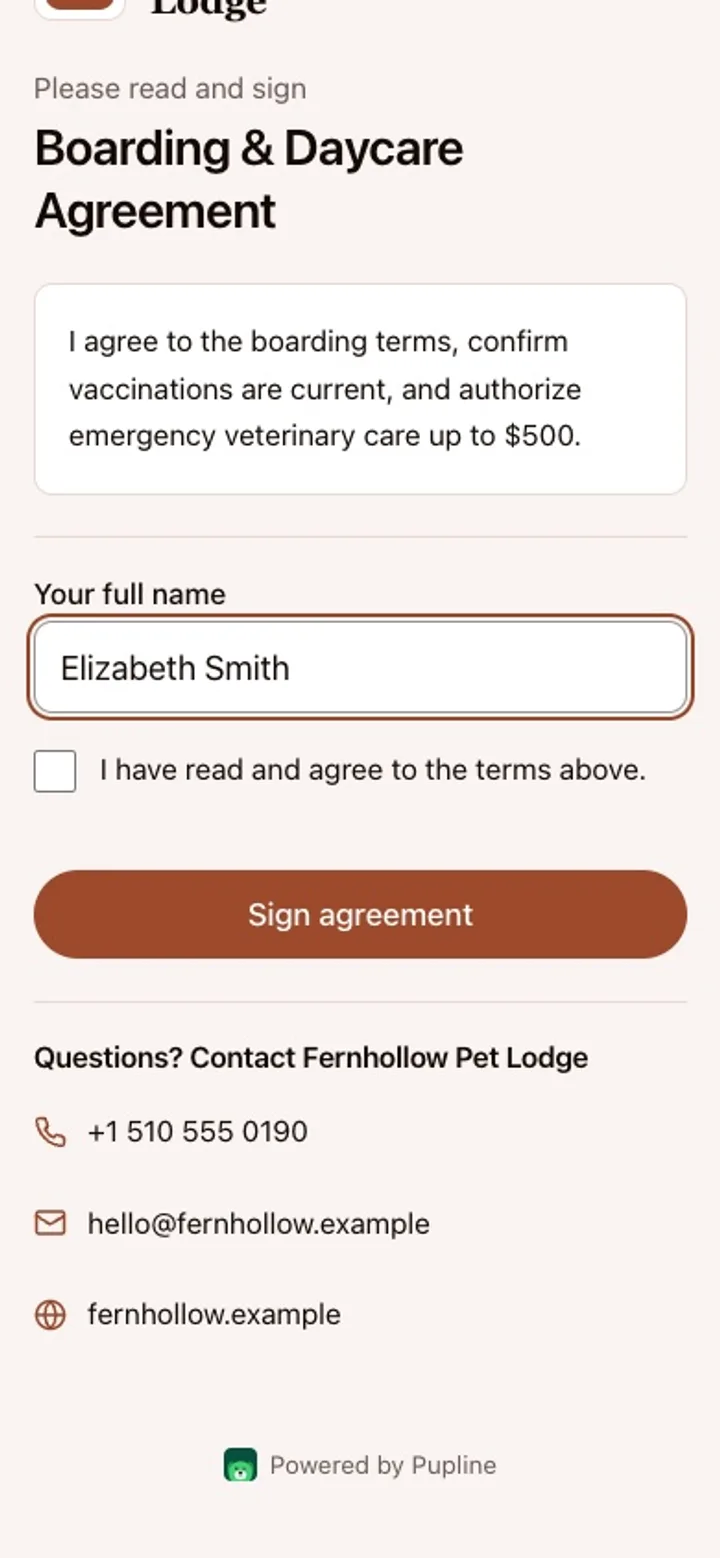
Booking software makes this much easier. Pupline, for example, sends e-signed agreements and waivers from a link, stores them on the client record, and asks owners to fill in a Care Card with feeding, medication and behavior details before each stay, which covers many of the sections above. Our ranking of the best dog boarding software and the best dog daycare software compares how other systems handle digital waivers.
The agreement is only one piece of the paperwork. Pair it with an intake form for new clients, a kennel card on each run, a clear invoice template and a friendly daycare report card at pickup.
Frequently asked questions
What should be included in a dog boarding contract?
The owner and dog details, booked dates and services, prices, deposit and cancellation terms, vaccination and health requirements, emergency vet authority with a spending limit, behavior disclosure, group play risks, collection and late pickup rules, an abandonment clause, photo consent, and signatures. UK licensed boarders also need specific written consents.
Is a dog daycare waiver legally binding?
It depends on where you operate and how it is written. Courts generally look at whether the terms were clear, fair and agreed before the service. Some liability cannot be waived; in the UK, for example, a business cannot exclude liability for death or personal injury caused by negligence. Have a local lawyer review your waiver.
Can a boarding kennel keep my deposit if I cancel?
Usually yes, if the agreement you signed says so and the term is fair. Most businesses refund or credit deposits with enough notice and keep some or all of it for late cancellations, especially at peak times. In the UK, unfair terms in consumer contracts are not binding, so keep cancellation fees proportionate.
Do I need a new agreement for every stay?
Not necessarily. Many businesses use one master agreement per client, plus a short booking confirmation for each stay, and ask for a new signature once a year or whenever terms change. Health and medication details should be confirmed before every stay, because they change more often than your terms.
Can clients sign the boarding agreement online?
Many boarding and daycare businesses collect agreements electronically, and most booking software supports e-signatures. Ask your lawyer to confirm that electronic signatures are acceptable for your agreement in your jurisdiction, and make sure the system records who signed, when, and which version of your terms they agreed to.
What is the difference between a boarding agreement and a daycare waiver?
A boarding agreement covers an overnight stay, so it includes deposits, cancellations, feeding, medication, collection and abandonment. A daycare waiver is shorter and focuses on the temperament assessment, the inherent risks of group play, vaccinations and emergency care. Many businesses use both, depending on the service booked.
Sources
Keep reading
- GuidesDog Boarding Business Plan: A Full Outline With a Worked Example
- GuidesDog Boarding Invoice Template: Free to Copy, With Tax Notes
- GuidesDog Boarding Licence UK: The Complete 2026 Guide
- GuidesDog Boarding Prices in 2026: What a Night Really Costs
- GuidesDog Daycare Intake Form: Free New Client Template
- GuidesDog Daycare License Requirements: What You Need Before You Open