Dog Daycare Intake Form: Free New Client Template
Everything a new client and pet form should collect, which vaccines daycares and kennels commonly require and why, and a full template you can copy.
This site is published by the team behind Pupline, our top pick. Who we are
A dog daycare intake form is the questionnaire a new client fills in before their dog's first visit. It collects the owner's contact details, the dog's health and vaccination record, behavior history and care instructions, so you can decide whether the dog is a good fit and look after it safely from day one. This guide explains what a good new client form for dog daycare should ask, which vaccinations daycares and kennels commonly require, how to run a temperament assessment, and gives you a full dog boarding intake form template you can copy.
The vaccine section summarizes published guidance and the law in a few places as examples. It is not veterinary or legal advice. Set your vaccine policy with your own vet, and check the rules in your state, province or council.
Why the intake form matters
The intake form does three jobs.
It protects the dog. Medication, allergies, medical conditions and handling notes all start here, and they flow onto the kennel card or daycare board that staff use every day.
It protects the other dogs and your staff. Vaccination records reduce the spread of disease in a group setting, and an honest behavior history helps you decide whether a dog is ready for group play.
It protects the business. If a dog bites someone or falls ill, a signed form shows what the owner told you and what you checked. In England, licensed day care and boarding businesses must keep a register for each dog covering medical and behavioral history, diet, consent forms and vaccination, worming and flea treatment dates, and keep it for at least 3 years, according to Defra's dog day care guidance. Your intake form is where most of that register starts.
What to include on a new client form for dog daycare
Group the questions in the order an owner thinks about them: about me, about my dog, my dog's health, my dog's behavior, my dog's routine, and what I agree to.
Owner and household
- Full name, address, mobile phone and email
- A second contact in the household
- An emergency contact who will not be travelling with the owner, with their phone number
- People authorized to drop off and collect
- How they heard about you (useful for your marketing)
Dog identity
- Name, breed, color, sex, neutered or spayed
- Date of birth or age
- Weight
- Microchip number
- Local dog license number, where your city requires dog licensing
- A recent photo
Vet and insurance
- Vet practice, phone number and address
- Pet insurance company and policy number, if any
- Consent to contact the vet for records and in an emergency
Vaccinations and parasite control
Ask for the date each vaccine was given and the date it expires, and ask the owner to upload or email proof from the vet. We cover which vaccines to ask for in the next section. Also ask about flea, tick and worm treatment, with dates.
Health
- Current medical conditions
- Medications, with dose, timing and how they are given
- Allergies (food, medication, environmental)
- Previous surgeries or injuries, and any mobility limits
- Recent illness, especially coughing, vomiting or diarrhea in the last two weeks
- For females, whether she is in season or due to be
Behavior
- Has the dog ever bitten or injured a person or another dog? If so, what happened?
- How does the dog react to other dogs, large dogs, small dogs, puppies?
- How does the dog react to strangers, men, children, being handled?
- Any resource guarding of food, toys, beds or people?
- Fears or triggers, such as thunder, vacuums or hats
- History of escaping, jumping fences or chewing through crates
- Previous daycare or boarding experience, and how it went
- Training level and cues the dog knows
Routine and care
- Food, amount and feeding times (for full-day daycare or boarding)
- Treats allowed or not
- Toilet habits and any accidents to expect
- Nap habits and crate training
- Comfort items
Consents and policies
- Agreement to your terms, vaccine policy and cancellation policy
- Emergency vet authority and a spending limit
- Group play consent
- Photo and social media consent
- Off-lead and group walk consent, where relevant
The longer agreement and waiver belong in a separate document. Our dog boarding contract template includes a full boarding agreement and a daycare waiver you can pair with this form.
Vaccination requirements commonly asked for
There is no single vaccine list that every daycare uses, but the requirements across the US, Canada, the UK and Australia look similar. They are built around the core vaccines vets recommend for all dogs, plus vaccines for diseases that spread easily where dogs mix.
| Vaccine | Protects against | Why daycares ask for it | Typical renewal |
|---|---|---|---|
| Rabies | Rabies virus | Required by law for dogs in most US states | Per local law and the vaccine label |
| DHPP, DAPP or DA2PP | Distemper, adenovirus (hepatitis), parvovirus, often parainfluenza | Core vaccines for all dogs; parvovirus and distemper spread readily | Core components at least every 3 years after the initial course |
| Bordetella | Bordetella bronchiseptica, a main cause of kennel cough | Spreads easily where dogs mix; required by many facilities | Usually yearly |
| Leptospirosis | Leptospira bacteria | Core in UK guidance; a licence condition for English boarders | Yearly |
| Canine influenza | Canine influenza virus | Some facilities ask for it; ask your vet whether it is recommended locally | Per vet advice |
Rabies
In the US, rabies vaccination for dogs is a legal requirement in most states. The Animal Legal and Historical Center's table of state rabies laws notes that about ten states have no state-level requirement, and in some of those, such as Utah, it is left to local governments. Even where state law is silent, most daycares and kennels set rabies vaccination as a condition of entry, and it is a sensible house rule. Rabies is not on the BSAVA core list or in the Defra licence conditions for dogs in the UK, so UK daycares do not usually ask for it unless a dog has travelled.
DHPP and its variants
DHPP (also written DAPP or DA2PP) is a combination vaccine covering canine distemper, adenovirus (which causes infectious canine hepatitis), parvovirus and parainfluenza. The British Small Animal Veterinary Association's vaccination summary lists distemper, adenovirus or infectious canine hepatitis, parvovirus and leptospirosis as core dog vaccines that "should be considered for all animals", with most core vaccines given again "at least every 3 years". Because different vets use different products and schedules, ask for the expiry date printed on the vet's record rather than assuming a fixed interval.
Bordetella (kennel cough)
Kennel cough is the illness owners most associate with daycare and boarding. BSAVA describes the kennel cough vaccine as non-core, but says "vaccination should be considered for dogs before kennelling" and in other situations where dogs mix, and notes that kennel cough vaccination needs annual boosters. Some local rules go further. For example, the Animal Medical Center in New York reports that the New York City Health Code (section 161.15(e)) requires dogs entering training facilities, grooming parlors and boarding kennels to be actively vaccinated against Bordetella, which currently means yearly revaccination in line with the manufacturer's label.
Explain to owners that the vaccine reduces the risk and severity of kennel cough but does not remove it, which is why your waiver mentions it. Ask owners to vaccinate well before the first visit rather than the day before, and ask their vet how long before attendance the specific product needs.
Leptospirosis
BSAVA lists leptospirosis as a core vaccine and says it needs annual boosters. In England, it is also a licence condition: Defra's day care and boarding guidance requires current vaccination against canine parvovirus, canine distemper, infectious canine hepatitis and leptospirosis, and says kennel cough vaccination may also be required. US and Canadian daycares vary on whether they require it, so follow your vet's advice for your area.
Puppies, titre tests and exemptions
Puppies need special handling on the intake form. Defra's guidance says primary vaccination courses must be completed at least 2 weeks before a dog is admitted, and that dogs under one year old need written procedures and separate housing from older dogs unless the owner consents in writing. Many daycares set a minimum age for group play for the same reason.
Some owners ask to use a titre test (an antibody blood test) instead of a booster. Defra allows licence holders in England to accept a recent protective titre test certificate in place of a booster at their discretion. BSAVA notes that antibody tests are not a substitute for every core vaccine, "most importantly Leptospira". Decide your titre test policy with your vet and write it down.
For dogs that cannot be vaccinated for medical reasons, ask for a signed letter from the vet and decide case by case. Many facilities will not accept unvaccinated dogs into group play at all.
Temperament assessment
The intake form tells you what the owner thinks of their dog. The temperament assessment tells you what the dog actually does in your space.
In England, Defra's day care guidance says "all dogs must be screened before being admitted to the premises," that each screening must be recorded, and that it should check whether a dog is anxious or stressed around other dogs or people or poses a danger. Outside England there is often no legal requirement, but almost every reputable daycare does an assessment anyway.
A simple assessment process
- Review the form first. Look for bite history, reactivity, guarding and medical issues before the dog arrives.
- Meet the dog alone. Watch how they enter, how they take treats, and how they respond to handling of paws, ears and collar.
- Introduce one calm, well-socialized dog. Choose a staff dog or a reliable regular, on neutral ground, with leads loose.
- Add a small group. If the first introduction goes well, add two or three more dogs of similar size and play style.
- Watch for stress signals. Tucked tail, lip licking, whale eye, freezing, hiding, constant mounting or repeated corrections from other dogs.
- Record the outcome. Pass, pass with conditions (for example small dogs only, or half days), or not suitable for group play, with a note of why.
- Tell the owner kindly. If a dog is not suited to group play, suggest alternatives such as solo care, walks or a training referral.
Re-assess after long breaks, after any incident, and when a puppy reaches adolescence, because behavior can change as dogs mature.
Dog daycare and boarding intake form template
Copy this template into your word processor, form builder or booking system. The boarding section at the end is optional for daycare-only businesses.
New client and pet intake form
Free to copy and adapt. Use your browser's Print to save as PDF.[Business name] | New client and pet registration
Please complete one form per dog and return it, with vaccination records from your vet, at least [X] days before your first visit.
Section 1: Owner details
- Full name: [Name]
- Address: [Address]
- Mobile: [Phone] | Email: [Email]
- Second household contact: [Name, phone]
- Emergency contact (not travelling with you): [Name, relationship, phone]
- People authorized to drop off and collect: [Names]
- How did you hear about us? [Answer]
Section 2: Your dog
- Name: [Name]
- Breed: [Breed] | Color: [Color]
- Sex: [ ] Male [ ] Female | Neutered or spayed: [ ] Yes [ ] No
- Date of birth: [Date] | Weight: [Weight]
- Microchip number: [Number]
- Dog license number (if required locally): [Number]
- Photo attached: [ ] Yes
Section 3: Vet and insurance
- Vet practice: [Name]
- Vet phone and address: [Details]
- Pet insurance: [Insurer, policy number] or [ ] None
- I authorize [Business name] to contact my vet for records and in an emergency.
Section 4: Vaccinations (please attach proof from your vet)
| Vaccine | Date given | Expiry date |
|---|---|---|
| Rabies (where required) | [Date] | [Date] |
| DHPP, DAPP or DA2PP | [Date] | [Date] |
| Bordetella (kennel cough) | [Date] | [Date] |
| Leptospirosis | [Date] | [Date] |
| Canine influenza (if required) | [Date] | [Date] |
| Other: [Name] | [Date] | [Date] |
- Titre test certificate instead of a booster: [ ] Yes, attached [ ] No
- Flea and tick treatment, product and date: [Details]
- Worming, product and date: [Details]
Section 5: Health
- Medical conditions: [None or details]
- Medications (name, dose, time, how given): [None or details]
- Allergies (food, medication, other): [None or details]
- Past surgeries, injuries or mobility limits: [None or details]
- Any coughing, vomiting, diarrhea or illness in the last 14 days? [ ] No [ ] Yes, details: [Details]
- For females: in season now or expected soon? [ ] No [ ] Yes, dates: [Dates]
Section 6: Behavior
- Has your dog ever bitten, injured or attacked a person or animal? [ ] No [ ] Yes, details: [Details]
- With other dogs, my dog is: [ ] Very social [ ] Social with some dogs [ ] Selective [ ] Prefers no dogs
- With large dogs: [Notes] | With small dogs or puppies: [Notes]
- With strangers, men or children: [Notes]
- Guards food, toys, beds or people? [ ] No [ ] Yes, details: [Details]
- Fears or triggers: [Details]
- Has your dog ever escaped from a yard, crate or lead? [ ] No [ ] Yes, details: [Details]
- Previous daycare or boarding: [Where, how it went]
- Cues your dog knows: [Sit, down, wait, recall, other]
- Anything else we should know about how to handle your dog: [Details]
Section 7: Routine and care
- Food (brand and type): [Details] | Amount: [Amount] | Times: [Times]
- Treats: [ ] Allowed [ ] Not allowed [ ] Only these: [Details]
- Toilet habits: [Details]
- Crate trained: [ ] Yes [ ] No
- Naps: [Details]
- Comfort items brought from home: [Details]
Section 8: Consents
- I have read and agree to the terms of service, vaccine policy and cancellation policy.
- My dog may join supervised group play after passing a temperament assessment.
- If I cannot be reached, you may obtain emergency veterinary care up to [amount], and I will pay for it.
- You may share photos and videos of my dog on social media.
- My dog may be walked off lead in a secure area (where relevant).
- My dog may be walked with dogs from other households (where relevant).
Section 9: Boarding only (complete if booking overnight stays)
- Sleeping habits and bedtime routine: [Details]
- Night-time toilet needs: [Details]
- Medication storage instructions: [Details]
- Items you will bring (bed, food, toys, lead): [List]
- Preferred contact method during the stay: [Phone, email, none unless urgent]
Signature
Owner signature: [Signature] | Date: [Date]
For office use
- Vaccinations verified by: [Staff name] on [Date]
- Temperament assessment: [Date], outcome: [Pass, pass with conditions, not suitable], assessed by: [Name]
- Playgroup: [Group]
- Notes: [Details]
Tips for collecting intake forms
- Send the form with the booking confirmation. Ask for it back, with vaccine proof, a few days before the first visit so you have time to chase gaps.
- Accept proof from the vet, not the owner's memory. A photo of the vaccination certificate or an email from the practice is enough.
- Record expiry dates and set reminders. A vaccine that lapses mid-stay is a common reason for awkward conversations at the desk. Remind owners a few weeks before each expiry.
- Review health and medication before every stay. Owners forget to tell you about new medication. A short pre-visit check catches it.
- Keep one record per dog, linked to one household. Siblings share owners but not medications or behavior notes.
- Ask again once a year. Re-confirm details annually, along with your terms.
Paper forms versus online intake
Paper forms are fine for a handful of new clients a month. They become a problem when you need to find one dog's vaccine expiry at 7am on a holiday weekend, or when a staff member types the wrong date into a spreadsheet.
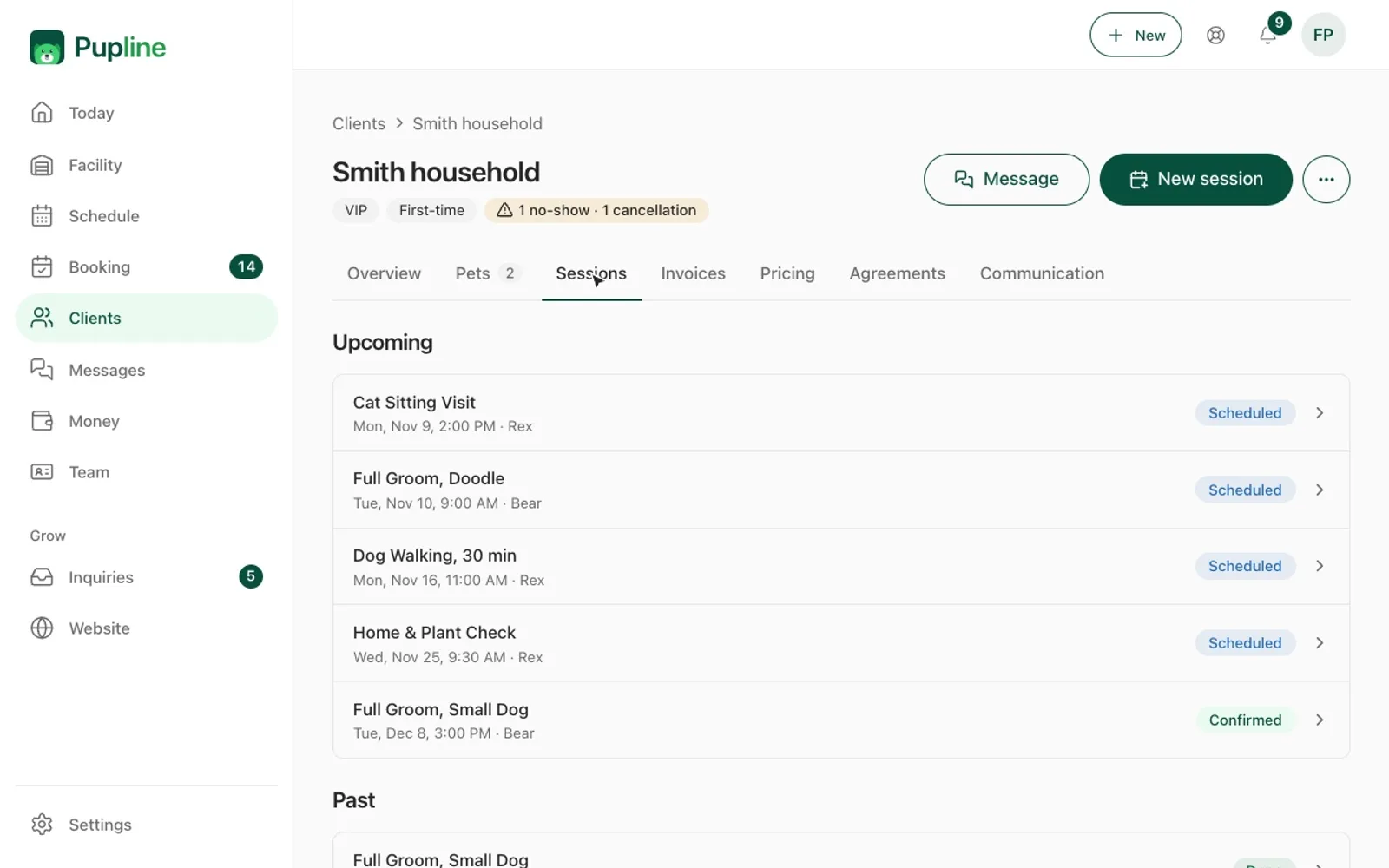
Online intake fixes most of this. The owner fills in the form on their phone before the visit, uploads vaccine certificates, signs your agreement, and the details land in the pet's record without retyping. Pupline, for example, asks owners to complete a Care Card before each stay, keeps households, medications, allergies and dogs to keep apart on each pet record, and tracks vaccinations such as rabies, DHPP and Bordetella with warnings before they lapse. Agreements and waivers are e-signed from a link, and owners can request bookings without creating a login. Our roundups of the best dog daycare software, the best dog boarding software and the best kennel software compare how other systems handle online forms and vaccine tracking.
If you are still planning your business, the intake form is a good place to start writing policies, because it forces decisions about vaccines, ages and group play. Our guides on how to start a dog daycare, dog daycare staff ratios and dog daycare license requirements cover the rest, and UK readers should also read the UK dog boarding licence guide.
Frequently asked questions
What should a dog daycare intake form include?
Owner and emergency contacts, the dog's identity and microchip, vet and insurance details, vaccination dates and expiry dates with proof, medical conditions, medication and allergies, behavior history including any bites, feeding and routine, and consents for group play, emergency vet care and photos. Boarding forms add sleep and overnight care details.
What vaccines are required for dog daycare?
Requirements vary by facility and location, but most ask for rabies where required by law, a distemper, hepatitis and parvovirus combination such as DHPP, and Bordetella for kennel cough. In England, licence conditions require leptospirosis too. Some facilities also require canine influenza. Check your vet's advice and local rules.
How long before daycare should my dog get the Bordetella vaccine?
It depends on the product and whether it is a first dose or a booster, so ask your vet. Many facilities ask owners to vaccinate well before the first visit rather than the day before, because a dog vaccinated for the first time needs time to respond. Annual boosters are typical.
Do I need a temperament test for dog daycare?
Almost every reputable daycare assesses new dogs before group play. In England, Defra's day care guidance requires every dog to be screened before admission and the screening recorded. Elsewhere it is usually a house rule. The assessment checks how a dog copes with handling, new people and other dogs.
Can a daycare accept a titre test instead of vaccines?
Some can. In England, licensed boarders and daycares may accept a recent protective titre test certificate instead of a booster at their discretion. BSAVA notes antibody tests are not an alternative for every core vaccine, most importantly leptospirosis. Set a written titre policy with your vet.
How should I store client vaccination records?
Keep a copy of the vet's certificate on each pet's record, note the expiry date of every vaccine, and set reminders before they lapse. In England, licensed businesses must keep records for at least three years. Software that warns you before vaccines expire saves a lot of checking at the front desk.
Sources
Keep reading
- GuidesDog Boarding Business Plan: A Full Outline With a Worked Example
- GuidesDog Boarding Contract Template and Dog Daycare Waiver
- GuidesDog Boarding Invoice Template: Free to Copy, With Tax Notes
- GuidesDog Boarding Licence UK: The Complete 2026 Guide
- GuidesDog Boarding Prices in 2026: What a Night Really Costs
- GuidesDog Daycare License Requirements: What You Need Before You Open