How to Start a Dog Daycare Business in 2026
A practical, step-by-step plan for opening a dog daycare, with real licence fees, insurance costs, franchise investment ranges and the rules that differ by country.
This site is published by the team behind Pupline, our top pick. Who we are
To start a dog daycare, you need to confirm local demand, find a building that zoning allows you to use for dogs, get the right licence or registration, insure the business, hire and train staff to a safe ratio, set prices that cover your costs, and put booking, vaccination and payment systems in place before your first dog arrives. The order matters: zoning and licensing decide whether a building works at all, so settle them before you sign a lease. This guide walks through each step, with real fees, insurance costs and investment figures, and notes where the US, UK, Canada and Australia differ.
Step 1: Research your local market
Daycare is a local business: customers drop off and pick up every visit, so they want a daycare near home or work. So national numbers only tell you the market is big. The American Pet Products Association reports that 95 million US households own a pet (2025 National Pet Owners Survey) and that Americans spent $158 billion on their pets in 2024, including $14.3 billion on "other services" such as boarding, grooming, training, pet sitting and walking.
What you need is local evidence:
- Competitors within 20 minutes. List every daycare, kennel and home boarder. Note their prices, opening hours, group sizes, reviews and whether they have waiting lists.
- Prices. Goose's 2026 research put the average US full-day daycare price at $33.41, with state averages from $24.85 to $48.92. Our dog daycare prices guide has UK, Canadian and Australian figures.
- Demand signals. Dense housing, apartments, commuter neighbourhoods and new housing estates with young professionals tend to produce daycare customers. Waiting lists and full booking calendars at competitors are the best sign of all.
- Gaps. Is nobody offering early opening, small-dog groups, training add-ons or puppy socialisation? A clear gap is easier to market than "another daycare".
The 2026 benchmarking survey by IBPSA, The Dog Gurus and PocketSuite, reported by Global Pet Industry, found that among 457 operators, boarding made up 42.1% of revenue, daycare 21.7%, training 19.3% and grooming 10.1%. Many successful daycares add boarding or training once they are established, so think about whether your building could support that later.
Step 2: Decide on your model
There are three common routes.
Independent facility daycare. You lease or buy a building, fit it out and build your own brand. This gives you full control and no royalties, but you carry all the risk and need to learn everything yourself. We could not find a reliable published figure for the cost of opening an independent daycare, because it depends so heavily on rent, building condition and size.
Franchise. You pay for a brand, a playbook and support. Dogtopia's own franchise page estimates an initial investment of $664,355 to $1,478,820, including a $49,500 franchise fee, and asks for at least $300,000 in liquid capital and a $1 million net worth. For Camp Bow Wow, 1851 Franchise reports a 2026 initial investment range of $954,606 to $1,229,536 and a $50,000 franchise fee, with a royalty of 3.5% of net revenue in year one rising to 7% after that. The same report cites Item 19 figures showing mean FY2025 gross sales of about $1.09 million across 207 locations. These figures come from franchise disclosure documents, so read the current FDD yourself before relying on them.
Home-based daycare. Some owners start with a handful of dogs at home. This is the cheapest route, but zoning, neighbour noise complaints and licensing often limit numbers sharply, and in England a home-based day care still needs a licence.
Step 3: Check zoning, planning and licensing
This is the step that sinks most plans, so do it before you commit to a building.
United States
Zoning is set by your city or county. Many commercial zones allow "kennels" or "animal services" only with a conditional or special use permit, and some do not allow them at all. Call the planning department with the exact address, describe the business (number of dogs, hours, outdoor areas, overnight stays) and ask what approvals you need. Noise, waste disposal and parking are the usual concerns.
Licensing varies by state. Colorado licenses pet animal care facilities under the Pet Animal Care Facilities Act, and its rules require at least one supervisor for every 15 dogs mixing in a common area (8 CCR 1202-15 Part 14). In Massachusetts, Ollie's Law requires municipalities to issue kennel licences and directs the state to set regulations for boarding kennels and daycares, due in 2026. Many other states leave daycares to local kennel licences or have no specific rule. Our dog daycare license guide goes into more detail.
United Kingdom
In England, dog day care is a licensable activity under the Animal Welfare (Licensing of Activities Involving Animals) (England) Regulations 2018. You apply to your local council, which inspects against Defra's dog day care statutory guidance. Key requirements include no more than 10 dogs per staff member, 6 square metres of space per dog, screening every dog before admission, seeing up-to-date vaccination records and an isolation area for sick dogs.
Fees vary a lot by council. Buckinghamshire charges £719 for day care for dogs from 1 April 2026. Hart District Council charges £318 for boarding activities including day care with fewer than 20 animals in 2026/27. Some councils add vet inspection fees on top. You may also need planning permission for a change of use, which is a separate application to the planning department. Scotland, Wales and Northern Ireland have their own regimes. See our UK dog boarding licence guide for the star rating system and the application process.
Canada
Rules are mostly municipal. The City of Winnipeg, for example, sets one staff member per 25 small dogs or 20 large dogs, 20 or 35 square feet per dog, and requires a client tracking system with vaccination records. Check your city's animal services and zoning bylaws, and your province for any business registration rules.
Australia
Rules are set by states and councils. In Victoria, boarding establishments must register with their council as a Domestic Animal Business and follow the Code of Practice for the Operation of Boarding Establishments. Ask your council whether a day-only service falls under the same registration, and check planning approval for the site.
Step 4: Get insured
Daycare insurance protects you if a dog is injured, a dog injures a person or another dog, or a customer's dog escapes. Insureon's cost figures for kennels and pet boarding businesses (updated July 2025, based on the median of policies bought through Insureon) are a useful US benchmark:
| Policy | Median monthly cost | Annual |
|---|---|---|
| General liability | $53 | $639 |
| Business owner's policy | $92 | $1,105 |
| Professional liability | $88 | $1,051 |
| Workers' compensation | $124 | $1,485 |
| Commercial auto | $245 | $2,942 |
Make sure your policy includes animal bailee or "care, custody and control" cover, which protects you for injury to the dogs in your care. Insureon notes that animal bailee cover can be added to general liability as an endorsement. In the UK, Canada and Australia, specialist pet business insurers offer similar packages, and GOV.UK says UK employers need employers' liability insurance of at least £5 million as soon as they become an employer. Get at least three quotes, and ask each insurer exactly what happens if a dog is injured in group play.
Step 5: Find and fit out a facility
What to look for in a building:
- Zoning approval for your use, confirmed in writing.
- Enough usable floor space for your target capacity. At England's 6 m² per dog, 40 dogs need 240 m² of play space before you count reception, a kitchen, storage, an isolation room and staff areas.
- Outdoor space or a nearby safe area for toileting.
- Separate rooms so you can split dogs by size and play style.
- Distance from neighbours, because barking is the most common source of complaints.
- Parking and a safe drop-off at peak times.
Fit-out priorities are non-slip, non-porous flooring that can be disinfected, drainage, good ventilation, double-door entry systems so dogs cannot escape through reception, secure fencing outside, and climate control. Leave room for webcams if you plan to offer them, since owners increasingly expect them.
Step 6: Hire and train staff
Staff are your largest cost and your biggest risk. Plan the team around your staff to dog ratio, which is commonly 1:10 to 1:15 in industry guidance and set by law in some places (1:10 in England, 1:15 in Colorado). Read our dog daycare staff ratio guide for the full rules and the capacity math.
Training should cover canine body language, group play management, breaking up fights safely, first aid, cleaning and disease control, and your emergency plan. In England, staff need a formal qualification such as an Ofqual-regulated Level 2, or must show relevant knowledge and experience, and the higher star ratings need at least one full-time staff member with a Level 3 qualification.
Step 7: Write your policies and forms
Before opening, prepare:
- Client agreement covering liability, vaccinations, payment, cancellations and emergency vet authorisation. Start from our dog boarding contract template.
- Intake form with health, behaviour, feeding and emergency contacts. See our dog daycare intake form.
- Temperament assessment process for every new dog.
- Vaccination policy. Commonly rabies, DHPP or DHLPP and Bordetella in the US; distemper, parvovirus, hepatitis and leptospirosis in England's licensing guidance.
- Incident and emergency procedures.
- Report card format for daily updates. Our dog daycare report card guide has examples.
Step 8: Set your prices
Build prices from your cost per dog-day, then check them against the local market. A simple ladder works: a single full day, a half day at roughly 70% of the full-day price, 10 and 20-day packs at 5% to 20% off, and a monthly membership for regulars. Our guides to dog daycare prices and dog daycare packages work through the math with real examples, and the dog boarding business plan shows how pricing and occupancy turn into a forecast.
Step 9: Choose your software
Run the business on a proper system from day one. Migrating later is possible but takes time, and starting on paper means you will be rebuilding client records within months. Look for:
- Online booking requests so customers can book outside office hours.
- Vaccination tracking with expiry warnings.
- E-signed agreements and waivers.
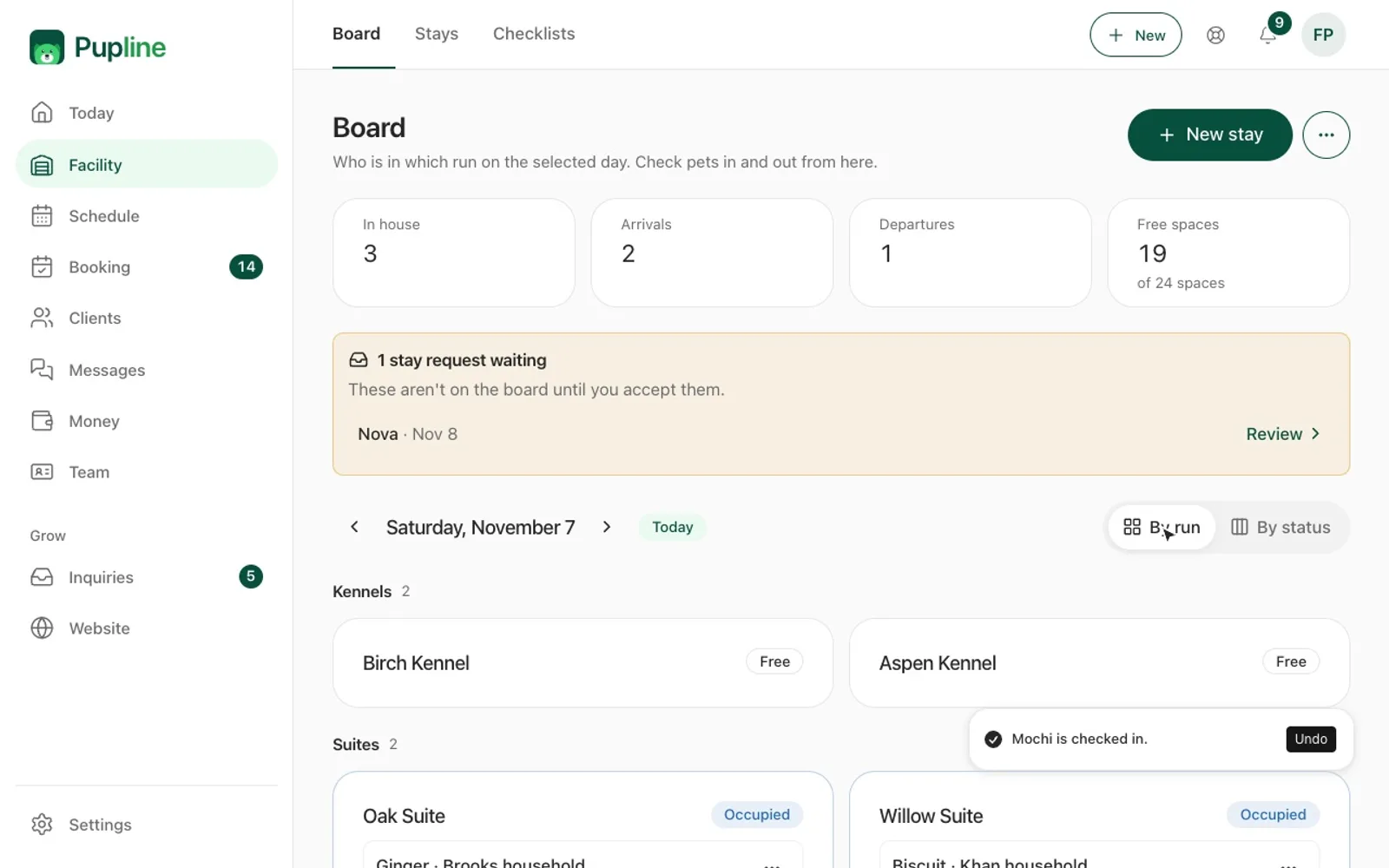
- Check-in and check-out, with a view of who is on site today.
- Packages, recurring days and invoicing with card payments.
- Report cards with photos.
Pupline, made by the team behind this site, covers all of these on every plan, starting at $99 a month for up to 25 pet spaces with unlimited staff accounts and no setup fee. It also includes a free website at yourname.pupline.app, which helps when you are launching before you have a full site. It suits a single independent location; it has no multi-location management and no built-in SMS yet. See the best dog daycare software for a full comparison.
Step 10: Market your opening
- Claim your Google Business Profile as soon as you have an address, and ask early customers for reviews.
- Run a pre-opening waiting list with an introductory offer for the first month.
- Hold free open days and assessments so owners can see the facility and staff.
- Partner locally with vets, groomers, trainers and pet shops that do not compete with you.
- Post daily photos on social media once you open: a happy playgroup is your best advert.
- Make the first day great and send a report card. First impressions turn trial days into packages.
Startup checklist
Dog daycare startup checklist
Free to copy and adapt. Use your browser's Print to save as PDF.Research and planning
- Competitor list with prices, hours and reviews (20-minute radius)
- Business plan with cost and revenue forecast
- Funding arranged (savings, bank loan, SBA or local small business loan)
Legal
- Business structure registered
- Zoning or planning approval confirmed for the exact address
- Licence or registration application submitted (council, state or city)
- Insurance: general liability with animal bailee cover, property, workers' comp or employers' liability
Facility
- Lease signed only after zoning is confirmed
- Flooring, drainage, ventilation and climate control
- Double-door entry and secure fencing
- Isolation area for sick dogs
- First aid kits and emergency plan posted
People
- Ratio and capacity plan
- Staff hired and trained (body language, group play, first aid)
- Rota covering opening, peak and closing hours
Operations
- Client agreement, intake form and vaccination policy
- Temperament assessment process
- Price list, packages and memberships
- Software set up with booking, vaccinations, payments and report cards
- Vet relationship for emergencies
Launch
- Google Business Profile and website live
- Waiting list and opening offer
- Open day scheduled
How much does it cost to start a dog daycare?
It depends heavily on rent, building condition and size, so there is no reliable single figure for independent daycares. Franchise disclosure figures give an upper benchmark: Dogtopia estimates $664,355 to $1,478,820 and Camp Bow Wow's 2026 range is reported at $954,606 to $1,229,536. A small home-based daycare costs far less but is limited in numbers.
Do I need a licence to open a dog daycare?
In England, yes: dog day care is licensable under the 2018 animal activity regulations, and fees in 2026 range from about £318 to over £700 depending on the council. In the US, Canada and Australia it depends on your state, city or council, and zoning approval is almost always needed.
How many dogs can one person look after in a daycare?
Industry guidance commonly suggests 10 to 15 dogs per staff member. England's licensing guidance sets a maximum of 10 dogs per staff member, Colorado requires at least one supervisor per 15 dogs in a shared play area, and Winnipeg allows one per 20 large or 25 small dogs.
What insurance does a dog daycare need?
At minimum, general liability with animal bailee or care, custody and control cover, plus property cover and workers' compensation or employers' liability once you have staff. Insureon's median for US kennels and boarding businesses is about $53 a month for general liability and $92 for a business owner's policy.
Is a dog daycare profitable?
It can be, but margins depend on occupancy and staffing. Camp Bow Wow's franchise disclosure reports mean FY2025 gross sales of about $1.09 million per location, though that is revenue, not profit. Independent daycares should model costs at realistic occupancy rather than full capacity.
Can I run a dog daycare from home?
Sometimes. You will need to check zoning or planning rules, which often limit commercial animal businesses in residential areas, and in England a home-based day care still needs a council licence that meets Defra's space and staffing standards. Neighbour noise complaints are a common problem.
Sources
- APPA: industry trends and stats
- IBPSA, The Dog Gurus and PocketSuite benchmarking survey, reported by Global Pet Industry (November 2026)
- Goose: pet daycare prices research (2026)
- Defra: dog day care licensing statutory guidance (updated June 2026)
- Buckinghamshire Council: animal licence fees (from April 2026)
- Hart District Council: animal licence fees 2026/27
- Colorado 8 CCR 1202-15 Part 14, via Cornell LII
- MSPCA-Angell: Ollie's Law
- City of Winnipeg: dog daycare requirements
- Business.gov.au: Victorian Code of Practice for the Operation of Boarding Establishments
- Insureon: pet boarding and dog day care insurance cost (updated July 2025)
- Dogtopia: franchise investment
- 1851 Franchise: Camp Bow Wow franchise cost (July 2026)
- SBA: write your business plan
- GOV.UK: employers' liability insurance
Keep reading
- GuidesDog Boarding Business Plan: A Full Outline With a Worked Example
- GuidesDog Boarding Contract Template and Dog Daycare Waiver
- GuidesDog Boarding Invoice Template: Free to Copy, With Tax Notes
- GuidesDog Boarding Licence UK: The Complete 2026 Guide
- GuidesDog Boarding Prices in 2026: What a Night Really Costs
- GuidesDog Daycare Intake Form: Free New Client Template