Dog Boarding Business Plan: A Full Outline With a Worked Example
Every section a lender or partner expects, plus a worked example for a 30-run kennel with daycare that shows how occupancy drives the whole forecast.
This site is published by the team behind Pupline, our top pick. Who we are
A dog boarding business plan sets out who your customers are, what you will charge, what it costs to open and run the kennel, and how many nights you need to sell to break even. The heart of it is the occupancy math: a kennel never runs full all year, and UK kennels typically average 60% to 75% occupancy according to KennelBooker, so your revenue forecast must be built on realistic occupancy, not capacity. Below is a full outline you can copy, followed by a worked example for a 30-run kennel with a daycare.
The same structure works for a dog daycare business plan or a kennel business plan. Swap in your own prices, costs and occupancy assumptions, and the math still holds.
Why a dog boarding business plan matters
Lenders, landlords and investors will ask for one. More importantly, it forces you to test the idea before you sign a lease. Many kennel plans look fine at 90% occupancy and fall apart at 60%, and you want to find that out on paper.
The business plan outline
The SBA's guide to writing a business plan lists the sections of a traditional plan. Here is how each one applies to a boarding kennel or daycare.
Dog boarding business plan outline
Free to copy and adapt. Use your browser's Print to save as PDF.Section 1: Executive summary (one page, written last)
- Business name, location, opening date
- Services: boarding (___ runs/suites), daycare (___ dogs), extras
- Target customers and why they will choose you
- Funding needed and what it pays for
- Headline numbers: year 1 revenue, break-even occupancy, year 3 profit
Section 2: Company description
- Legal structure and owners
- The problem you solve (for example: no licensed kennel within 20 minutes, waiting lists at existing daycares)
- What makes you different (smaller groups, webcams, longer hours, training, cat boarding)
Section 3: Market analysis
- Local demand: households, dog ownership, commuting patterns
- Competitor table: name, distance, nightly rate, daycare rate, capacity, reviews, waiting lists
- Pricing position: where you sit against competitors and why
Section 4: Organisation and management
- Owners' experience with dogs and with running a business
- Staffing plan: roles, hours, ratio, overnight cover
- Advisers: accountant, solicitor or attorney, vet, insurance broker
Section 5: Services and pricing
- Boarding rate card: base rate, size or suite tiers, extra dog sharing, peak surcharge
- Daycare: full day, half day, packs, memberships
- Add-ons: baths, medication, one-to-one play, walks, late checkout
- Policies: vaccinations, assessments, deposits, cancellations
Section 6: Marketing and sales
- Pre-opening: waiting list, open days, Google Business Profile, website
- Ongoing: reviews, referrals, vet and groomer partnerships, social media
- Retention: report cards, packages, memberships, member boarding perks
Section 7: Funding request
- Total startup cost by category
- Owner contribution and loan or investor amount
- Repayment terms you are asking for
Section 8: Financial projections
- Startup cost table
- Revenue model by month for year 1, annually for years 2 to 5
- Operating costs: staff, rent, utilities, insurance, licence, food, cleaning, software, marketing
- Break-even occupancy
- Low, expected and high scenarios
- Cash flow, including seasonality
Appendix: licence requirements, zoning or planning confirmation, floor plan, insurance quotes, lease terms
Section by section: what to write
Executive summary
Write this last. It should fit on one page and answer three questions: what you are opening, why it will work in this location, and how much money you need. Put the break-even occupancy in the summary, because it tells a lender in one number how much risk they are taking.
Market analysis
National data shows the market is large. The American Pet Products Association reports that 95 million US households own a pet and that $14.3 billion was spent on "other services" such as boarding, grooming, training, pet sitting and walking in 2024. But your plan lives or dies on local evidence.
Build a competitor table for every kennel, daycare and licensed home boarder within about 20 minutes. Record their nightly rate, daycare rate, capacity, opening hours, review scores and whether they have waiting lists at peak times. Call them as a customer and ask about availability at Christmas and in summer: if they are full, that is demand you can capture.
Use published benchmarks to sanity-check local prices. Goose's 2026 research found an average US boarding rate of $46.36 a night (median $45), and its daycare research found an average of $33.41 a day. Our dog boarding prices and dog daycare prices guides have UK, Canadian and Australian figures.
Services and revenue mix
Boarding is usually the biggest earner. The 2026 benchmarking survey by IBPSA, The Dog Gurus and PocketSuite, reported by Global Pet Industry, found that among 457 operators, boarding produced 42.1% of revenue, daycare 21.7%, training 19.3% and grooming 10.1%. Daycare matters beyond its own revenue: it fills quiet weekdays and turns local customers into boarding customers.
Organisation and staffing
Show who does what, and how the ratio drives headcount. In England, Defra's daycare guidance sets no more than 10 dogs per staff member, and Colorado requires one supervisor per 15 dogs in a shared play area. Our dog daycare staff ratio guide covers the rules and the capacity math. Do not forget overnight cover for boarding, and cover for holidays and sickness.
Startup costs
Startup costs vary too much by location and building to give a reliable typical figure for an independent kennel, so build your own from quotes. Franchise disclosures give an upper benchmark for a full commercial build-out in the US:
- Dogtopia: an estimated initial investment of $664,355 to $1,478,820, including a $49,500 franchise fee, according to Dogtopia.
- Camp Bow Wow: $954,606 to $1,229,536 in the 2026 disclosure, with a $50,000 franchise fee, as reported by 1851 Franchise.
An independent operator converting an existing building will usually spend less, but the categories are the same.
Startup cost worksheet
Free to copy and adapt. Use your browser's Print to save as PDF.| Category | Your quote |
|---|---|
| Lease deposit and first months' rent (or purchase deposit) | ___ |
| Planning or zoning applications | ___ |
| Licence application and inspection fees | ___ |
| Building works: drainage, flooring, walls, ventilation, heating and cooling | ___ |
| Runs, kennels or suites | ___ |
| Fencing and outdoor play areas | ___ |
| Isolation area | ___ |
| Laundry, kitchen and cleaning equipment | ___ |
| Webcams, security and fire safety | ___ |
| Furniture, reception and signage | ___ |
| Insurance (first year or deposit) | ___ |
| Software setup and first months | ___ |
| Website and pre-opening marketing | ___ |
| Staff hiring and training before opening | ___ |
| Working capital (at least 3 to 6 months of costs) | ___ |
| Total | ___ |
Some real figures for the smaller lines:
- Licence fees in England: Buckinghamshire charges £684 for dog kennel boarding and £719 for day care from April 2026.
- US insurance: Insureon's figures for kennels and pet boarding businesses put general liability at about $53 a month, a business owner's policy at $92 and workers' compensation at $124.
- Software: Pupline, made by the team behind this site, costs $99 a month for up to 25 pet spaces and $199 for up to 75, with no setup fee.
The revenue model: occupancy is everything
The formula
Boarding revenue = runs x nights in the year x occupancy x average revenue per run-night.
Average revenue per run-night includes the base rate, size and suite premiums, extra dogs sharing a run, peak surcharges and add-ons. It is usually higher than your base rate.
Daycare revenue = daycare capacity x operating days x average fill rate x average revenue per dog-day, after package discounts.
What occupancy to assume
The KennelBooker pricing guide says UK kennels typically run at 60% to 75% occupancy over a year and suggests aiming for 50% to 60% gross margin and 15% to 20% net margin. Occupancy is very seasonal: summer and Christmas can be full while January and February are quiet. A new kennel will also take time to build up, so assume lower occupancy in year one.
We found no comparable published occupancy benchmark for US or Australian kennels, so treat 60% to 75% as a reasonable planning range and test it against what local competitors tell you about their quiet and busy months.
A worked example
The numbers below are an illustration, not data. They use the US price benchmarks above and assumptions you should replace with your own quotes.
The business: a 30-run boarding kennel with a daycare licensed for 25 dogs, in a mid-sized US town.
Pricing assumptions:
- Base boarding rate $50 a night, slightly above Goose's $46.36 national average because the runs include daily group play.
- Average revenue per run-night $56, once suites, extra dogs sharing, holiday surcharges and add-ons are included.
- Daycare full day $35, with an average of $31 per dog-day after packs and memberships.
Occupancy assumptions: 65% boarding occupancy and 60% daycare fill in year two, once established.
Revenue
- Boarding: 30 runs x 365 nights = 10,950 run-nights available.
- At 65%: 10,950 x 0.65 = 7,117.5, so about 7,118 run-nights sold.
- At $56: 7,118 x $56 = $398,608.
- Daycare: 25 dogs x 250 weekdays = 6,250 dog-days available.
- At 60%: 6,250 x 0.60 = 3,750 dog-days sold.
- At $31: 3,750 x $31 = $116,250.
- Total revenue: $514,858.
Operating costs (illustrative)
| Cost | Annual | Notes |
|---|---|---|
| Staff wages and payroll costs | $226,000 | Ratio-driven daytime cover plus overnight and weekend staff |
| Rent | $72,000 | Replace with your lease quote |
| Utilities | $24,000 | Heating, cooling, water and laundry are heavy |
| Food, cleaning and supplies | $28,000 | Scales with nights and dog-days |
| Insurance | $6,000 | Insureon medians for liability, BOP and workers' comp total about $3,200; budgeted higher for a 30-run site |
| Card fees | $15,000 | Assumes about 3% on most revenue |
| Software | $2,388 | Pupline Standard at $199 a month |
| Marketing | $12,000 | Website, ads, open days |
| Repairs, licence, accounting, other | $24,000 | |
| Total | $409,388 |
That leaves an operating profit of about $105,470 before loan repayments, depreciation and tax, a margin of about 20%. It sits at the top of KennelBooker's 15% to 20% net margin guide, which is a sign the assumptions may be optimistic, so test the downside.
Scenarios
| Scenario | Boarding occupancy | Daycare fill | Revenue | Operating profit |
|---|---|---|---|---|
| Low | 50% | 45% | $393,788 | -$15,600 |
| Expected | 65% | 60% | $514,858 | $105,470 |
| High | 75% | 70% | $595,525 | $186,137 |
The low and high revenue lines use the same formula: at 50%, 5,475 run-nights x $56 = $306,600 plus 2,812.5 dog-days x $31 = $87,187.50. For simplicity, costs are held at $409,388 in every scenario. In reality food, cleaning and card fees fall a little when occupancy falls, and staff can be trimmed in quiet months, so the low case is slightly better than shown.
Break-even occupancy
To cover $409,388 of costs, with daycare at 60% fill bringing in $116,250, boarding must bring in $293,138. That is $293,138 / $56 = 5,235 run-nights, or 5,235 / 10,950 = about 48% boarding occupancy. Put this number in your executive summary: this business breaks even at roughly 48% boarding occupancy.
What moves the numbers most
- Average revenue per night. A $5 increase is worth $35,590 a year at 65% occupancy.
- Occupancy in quiet months. Daycare, length-of-stay discounts and off-peak promotions fill January and February.
- Staff scheduling. Staffing to the actual booking curve rather than a fixed rota is the biggest cost lever.
- Add-ons. The benchmarking survey found 71% of operators say at least one in ten customers buys add-ons, so a clear add-on menu lifts revenue per night.
Seasonality and cash flow
Boarding revenue is lumpy. Summer and Christmas bring full kennels and deposits, while late winter can run well below average. Show monthly cash flow for year one, and keep enough working capital to cover at least three months of costs at your low scenario. Take deposits on peak bookings, which improves cash flow and cuts no-shows.
How software supports the plan
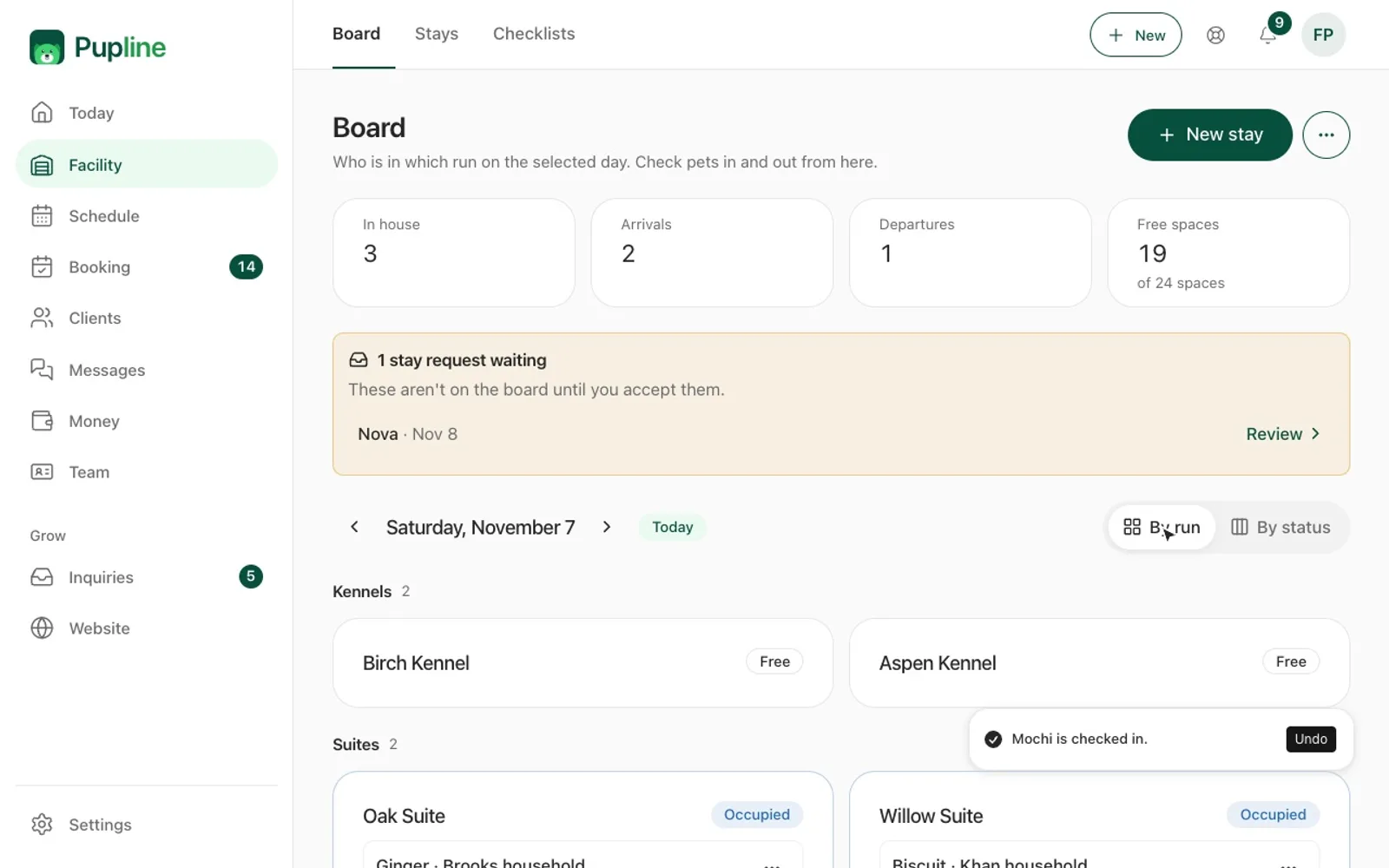
Your plan's numbers are only useful if you can measure them once you open. Boarding software shows occupancy by night, revenue per stay, add-on sales and no-shows, so you can compare actuals against the plan every month.
Pupline, made by the team behind this site, includes an occupancy board, per-night billing with holiday or peak rates and extras, deposits through your own Stripe account and online booking requests that let owners pick a run or suite with space. Its flat pricing by capacity ($99, $199 or $299 a month, with unlimited staff accounts) is easy to put into a cost forecast because it does not change with headcount. For a broader comparison, see the best dog boarding software and the best kennel software.
Related guides
- How to start a dog daycare for licensing, insurance and setup steps.
- Dog daycare packages for structuring prepaid revenue.
- UK dog boarding licence guide if you are opening in England.
- How to start a cattery if you plan to board cats too.
- Dog boarding contract template for your client terms.
What should a dog boarding business plan include?
An executive summary, company description, local market analysis with a competitor table, organisation and staffing, services and pricing, marketing, funding request and financial projections. The projections should include startup costs, a revenue model based on realistic occupancy, operating costs, break-even occupancy and low, expected and high scenarios.
What occupancy rate should I use for a kennel business plan?
KennelBooker says UK kennels typically run at 60% to 75% occupancy across a year. Use a lower figure for your first year while you build a customer base, and check local competitors' busy and quiet months. Always show what happens at a lower occupancy, such as 50%.
How much revenue can a dog boarding business make?
Revenue is runs x nights x occupancy x average revenue per night. For example, 30 runs at 65% occupancy and $56 average revenue per night is about $398,600 a year from boarding alone. Camp Bow Wow's franchise disclosure reports mean FY2025 gross sales of about $1.09 million per location.
How much does it cost to start a dog boarding business?
It depends on the building, location and size, so get quotes rather than relying on averages. Franchise disclosures give an upper benchmark for a full US build-out: Dogtopia estimates $664,355 to $1,478,820 and Camp Bow Wow's 2026 range is reported at $954,606 to $1,229,536, both including franchise fees.
Is a dog daycare business plan different from a boarding plan?
The structure is the same, but the revenue model uses dog-days instead of run-nights, and staffing is driven by the staff to dog ratio in playgroups. Daycare revenue is steadier across the year, while boarding peaks in summer and at Christmas, which is why many businesses offer both.
What is a good profit margin for a kennel?
KennelBooker's pricing guide suggests aiming for a 50% to 60% gross margin and a 15% to 20% net margin. Your actual margin depends mostly on occupancy, average revenue per night and how closely you match staffing to bookings.
Sources
- SBA: write your business plan
- Goose: pet boarding prices research (2026)
- Goose: pet daycare prices research (2026)
- KennelBooker: how to price kennel boarding rates (October 2025)
- IBPSA, The Dog Gurus and PocketSuite benchmarking survey, reported by Global Pet Industry (November 2026)
- APPA: industry trends and stats
- Insureon: pet boarding and dog day care insurance cost (updated July 2025)
- Buckinghamshire Council: animal licence fees (from April 2026)
- Dogtopia: franchise investment
- 1851 Franchise: Camp Bow Wow franchise cost (July 2026)
Keep reading
- GuidesDog Boarding Contract Template and Dog Daycare Waiver
- GuidesDog Boarding Invoice Template: Free to Copy, With Tax Notes
- GuidesDog Boarding Licence UK: The Complete 2026 Guide
- GuidesDog Boarding Prices in 2026: What a Night Really Costs
- GuidesDog Daycare Intake Form: Free New Client Template
- GuidesDog Daycare License Requirements: What You Need Before You Open