Dog Daycare Staff Ratio: What the Rules Say and How to Plan Capacity
The staff to dog ratios that regulators actually require, what industry voices recommend, and the math for working out how many dogs your daycare can take.
This site is published by the team behind Pupline, our top pick. Who we are
The most common dog daycare staff ratio is one staff member for every 10 to 15 dogs in a playgroup. England's licensing guidance sets a firm limit of 10 dogs per staff member (8 for the higher star ratings), Colorado requires at least one supervisor for every 15 dogs mixing in a play area, and some US states and Canadian cities set their own rules or none at all. Your real capacity is the lower of two numbers: the dogs your staff can safely supervise and the dogs your space and licence allow.
This guide sets out what regulators actually require, quoting the rules themselves, then walks through the capacity and staffing math for a real daycare. Rules change, and many are set locally, so always confirm the current requirement with your licensing authority before you plan around it.
Dog daycare staff ratio rules by country
| Where | Staff to dog ratio | Space per dog | Source |
|---|---|---|---|
| England (standard) | 1 staff member per 10 dogs or fewer | 6 m² per dog | Defra dog day care guidance, updated June 2026 |
| England (higher standard) | At least 1 full-time staff member per 8 dogs | 6 m² per dog | Defra dog day care guidance, updated June 2026 |
| Colorado, US | At least 1 supervisor per 15 dogs commingled in a common area | Not covered here | 8 CCR 1202-15 Part 14, effective July 2025 |
| Massachusetts, US | To be set by state regulations under Ollie's Law | To be set | MSPCA-Angell summary of Ollie's Law |
| Winnipeg, Canada | 1 per 25 small dogs, 1 per 20 large dogs | 20 sq ft (small) or 35 sq ft (large) | City of Winnipeg |
| Victoria, Australia | No ratio found in public summaries | See the Code of Practice | Victorian Code of Practice for Boarding Establishments |
| Industry guidance | 1:10 preferred, 1:15 at most | Not set | Adopt a Pet, 2022; Gingr blog |
England: Defra statutory guidance
Dog day care is a licensable activity in England under the Animal Welfare (Licensing of Activities Involving Animals) (England) Regulations 2018, and local councils inspect against Defra's statutory guidance. The dog day care guidance, last updated on 1 June 2026, is unusually specific:
- "Each member of staff should have 10 dogs or less to care for."
- Under the optional higher standards, which count toward a 4 or 5 star rating, there must be "at least one full-time member of staff per 8 dogs."
- "Each dog must have 6 square metres of space available to them within the premises."
- The licence "must clearly state the maximum numbers of dogs that are allowed on the premises."
- "A dog walker may walk no more than 6 dogs at the same time."
The guidance also requires every dog to be screened before admission, with a record kept of each screening, and staff to hold a formal qualification such as an Ofqual-regulated Level 2 or show "relevant and sufficient knowledge and experience." Vaccination records must be seen, and primary courses must be completed at least two weeks before a dog joins day care.
Scotland and Wales have their own licensing regimes, so check with your local authority there. Our UK dog boarding licence guide and dog daycare license guide cover the application process.
United States: a patchwork
There is no federal dog daycare ratio in the US. Rules come from states, and in many places from counties or cities through kennel licences and zoning conditions. Many states have no daycare-specific ratio at all.
Colorado is the clearest example of a state-level rule. Under the Pet Animal Care Facilities Act rules, 8 CCR 1202-15 Part 14 (effective July 15, 2025), "There must be at least one human supervisor for every 15 dogs commingled within each common area." The rule then sets a scale: 2 to 15 dogs need one supervisor, 16 to 30 need two, 31 to 45 need three, and 45 to 60 need four.
Massachusetts has Ollie's Law, which is bringing in state rules for kennels and daycares. According to the MSPCA-Angell summary, the law was signed on September 20, 2024, requires municipalities to issue and revoke kennel licences, and directs the state Department of Agricultural Resources to set regulations for boarding kennels and daycare facilities that "will be promulgated in 2026." If you operate in Massachusetts, check the Department's Ollie's Law page for the final staffing and group size rules.
Elsewhere, ask your state agriculture department and your city or county licensing office. Kennel licences sometimes include a maximum number of dogs, and that cap applies whatever your staffing.
Canada: city bylaws
Canadian rules are mostly municipal. The City of Winnipeg requires "one staff member for every 25 small dogs and one staff member for every 20 large dogs" in multiple-dog groups, with "20 sq. ft./dog for small dog play areas and 35 sq. ft./dog for large dog play areas." Daycares there must also keep a client tracking system that includes records of up-to-date vaccines. Winnipeg's ratio is looser than most industry advice, so treat it as a legal minimum rather than a target.
Other cities may have no daycare-specific rule, so check with your municipality before you sign a lease.
Australia: state codes and council registration
In Victoria, boarding establishments must be registered with their local council as a Domestic Animal Business and follow the Code of Practice for the Operation of Boarding Establishments made under the Domestic Animals Act 1994. We could not confirm a specific daycare staff ratio in the public summaries of the Victorian code, so read the full code and ask your council.
The Australian Veterinary Association's policy, ratified in 2019, says boarding establishments and dog day care centres "should be regulated and licensed," that staff "must have minimum training," and that standards should cover "staffing levels, carer competence and emergency plans." It does not set a number.
What industry voices recommend
Outside the law, the commonly quoted range is 1:10 to 1:15.
- An Adopt a Pet article by Julie Hecht, MSc (2022) gives the ratio as "1:10 (preferable), 1:15 tops," while noting that "no formal research has been done to validate these numbers." The same article quotes veterinary behaviourist E'Lise Christensen, DVM, recommending "a ratio of 1:5."
- Gingr, a daycare software vendor, advises daycares to maintain "one staff member for every 10-15 dogs".
So the sources disagree, and widely. A legal minimum like Winnipeg's 1:20 or 1:25 sits at one end, a behaviourist's 1:5 at the other, and most operators land between 1:10 and 1:15.
When to run a tighter ratio
A single number hides a lot. Run fewer dogs per person when:
- The group is new or mixed. New dogs, recent graduates of an assessment and groups with mixed sizes need more attention.
- Dogs are young or high energy. Adolescent dogs play harder and escalate faster.
- It is a transition time. Drop-off and pick-up, feeding and moving between yards are when most scuffles happen.
- The space is tight or has blind spots. A staff member who cannot see every dog cannot supervise them.
- Staff are new. A trainee should not be counted as a full supervisor.
And remember that one person on their own cannot both supervise a group and respond to an incident. If a fight breaks out, someone needs to step in while someone else keeps watching the rest.
How to work out your daycare's capacity
Your maximum is the lowest of three limits: space, staffing and your licence.
Step 1: The space limit
Measure the usable play area in each room or yard, excluding corridors, the reception area and staff-only space. Divide by the space you need per dog.
Using England's 6 m² rule, a daycare with 180 m² of usable indoor play space can hold 180 / 6 = 30 dogs. Using Winnipeg's large-dog rule of 35 sq ft, a 1,400 sq ft room holds 1,400 / 35 = 40 large dogs, or 70 small dogs at 20 sq ft.
If your rules do not set a space requirement, you still need one for planning. Many operators use their local rule, or the strictest rule they know of, as a buffer.
Step 2: The staffing limit
Multiply the number of supervising staff on the floor by your ratio. Count only people actually supervising dogs, not the front desk, the groomer or the manager doing payroll.
| Dogs in playgroups | Staff needed at 1:10 | Staff needed at 1:15 |
|---|---|---|
| 10 | 1 | 1 |
| 20 | 2 | 2 |
| 30 | 3 | 2 |
| 45 | 5 | 3 |
| 60 | 6 | 4 |
Then add cover for breaks, lunches and the busy hours of drop-off and pick-up.
Step 3: The licence limit
Your licence may set a maximum number of dogs. In England, Defra's guidance says the licence must state the maximum number of dogs allowed on the premises. That number wins over both of the above.
A worked example
A daycare in England has 240 m² of usable play space split into three rooms of 80 m² each, and is open 7:00 to 19:00.
- Space limit: 240 / 6 = 40 dogs (about 13 per room).
- Staff limit: at the standard 1:10, 40 dogs in three rooms need at least one person in each room, and four people across the three rooms once a room has more than 10 dogs.
- Licence limit: the council has licensed 40 dogs.
So capacity is 40 dogs. To be ready for a 4 or 5 star rating, the operator would need at least one full-time staff member per 8 dogs, which is five supervisors for 40 dogs.
Now the staffing cost. Twelve opening hours with four supervisors on the floor is 48 supervision hours a day, plus about 20% extra for breaks and handovers, which is roughly 58 paid hours. At 40 dogs a day, that is about 1.45 paid staff hours per dog. Multiply by your hourly wage plus employer costs to see what supervision costs per dog-day, and make sure your dog daycare prices cover it.
Staffing the day around your ratio
Attendance is not flat. Most daycares fill between 7:00 and 9:00, hit a peak mid-morning and empty out from 16:00. Staffing to the peak all day wastes money, and staffing to the average leaves you short at the worst times.
Daily daycare staffing plan
Free to copy and adapt. Use your browser's Print to save as PDF.Date: ___ Dogs booked: ___ (full day ___, half day ___) Ratio we are running today: 1 : ___ (lower for new or mixed groups)
| Time | Dogs on site | Supervisors needed | Names | Room or yard |
|---|---|---|---|---|
| 07:00 to 09:00 (drop-off) | ___ | ___ | ___ | ___ |
| 09:00 to 12:00 | ___ | ___ | ___ | ___ |
| 12:00 to 14:00 (rest, staff breaks) | ___ | ___ | ___ | ___ |
| 14:00 to 16:00 | ___ | ___ | ___ | ___ |
| 16:00 to 19:00 (pick-up) | ___ | ___ | ___ | ___ |
Front desk (not counted in the ratio): ___ First aid trained on site: ___ New dogs today (extra attention): ___ Dogs to keep apart: ___ Breaks covered by: ___
A few habits help:
- Book to your staffing, not the other way round. Close bookings for a day once you reach the number your scheduled staff can supervise.
- Use half days to smooth the curve. Half-day morning and afternoon slots spread attendance across the day.
- Group dogs by size and play style, which also makes it easier to run a tighter ratio where it matters.
- Write the ratio into your policies so staff know when to stop accepting walk-ins.
Signs your ratio is too loose
Ratios on paper only matter if they hold on the floor. These are the warning signs that a group has more dogs than its supervisors can handle:
- Staff are reacting rather than preventing. If most of a shift is spent breaking up scuffles, the group is too big or too mixed for the people watching it.
- Nobody can see the whole room. Blind corners, a door left open to a second yard or a staff member busy with one dog all mean the rest are unsupervised.
- Incident reports cluster at the same times. Repeated problems at drop-off or late afternoon usually point to understaffing at those hours rather than to the dogs.
- Breaks never happen. Staff who skip breaks to keep the ratio legal are a sign the rota is built for the average day, not the busy one.
- Owners notice. Complaints about scrapes, exhaustion or a dog coming home stressed deserve a look at the group size that day.
Keep a simple incident log with the date, time, room, number of dogs and staff present. After a month, patterns become obvious, and you have evidence to show an inspector or an insurer that you manage risk.
Talking to customers about your ratio
Owners increasingly ask about staff ratios before they book, especially after high-profile incidents in the news. Put your ratio, your group sizes and how you split dogs by size and play style on your website. A clear answer such as "never more than 12 dogs per person, and smaller groups for puppies" builds trust and justifies a higher price than a daycare that avoids the question.
How software helps with ratios and capacity
The hard part of a ratio is knowing, in real time, how many dogs are actually on site and who is coming. On a whiteboard, a late drop-off or an extra walk-in can tip a room over its limit without anyone noticing.
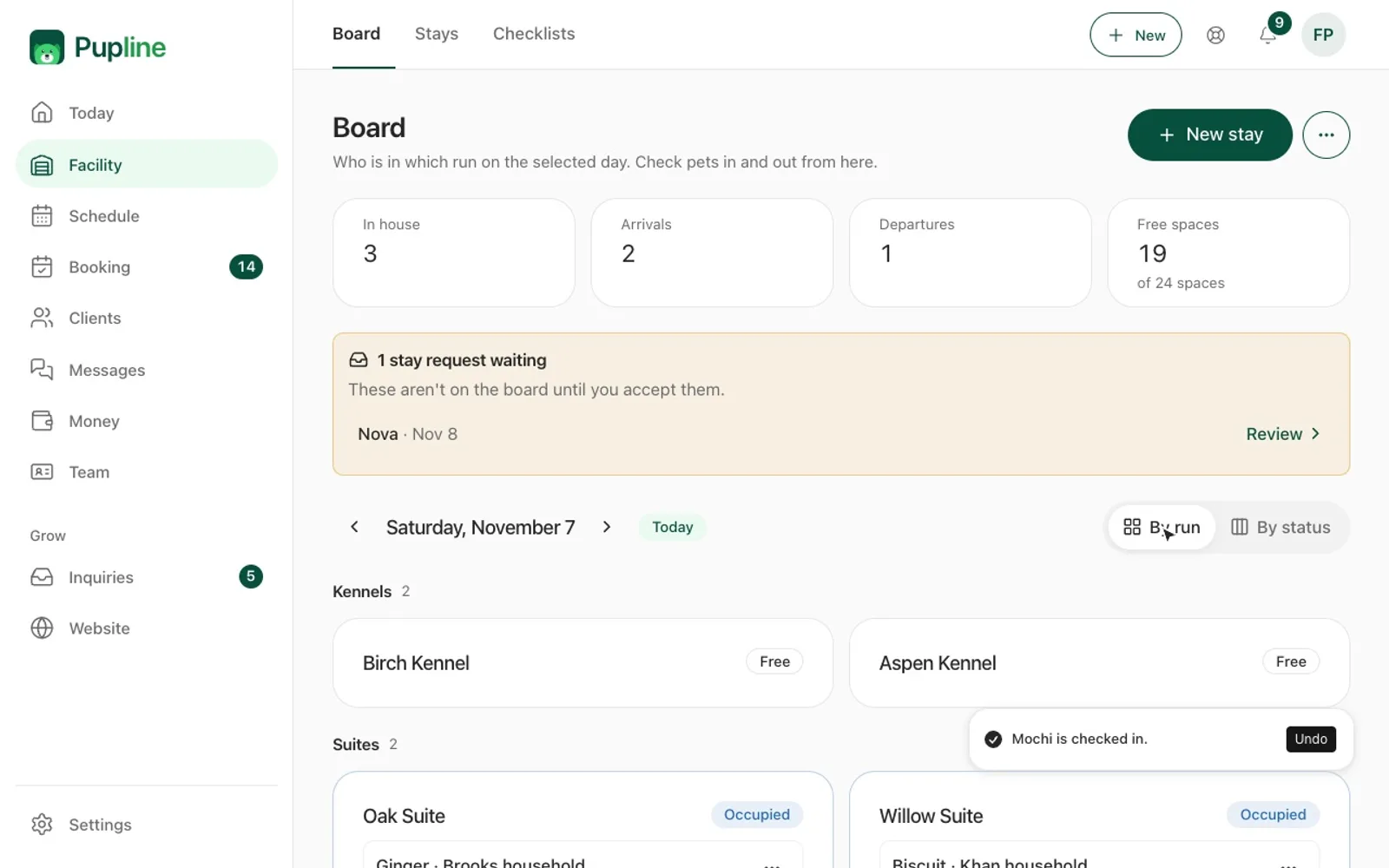
Daycare software shows today's bookings, check-ins and departures in one place, so you can see headcount through the day and stop taking bookings when you hit capacity. Pupline, made by the team behind this site, has an occupancy board showing who is in which run or room today, arrivals, departures and free spaces, along with check-in and check-out timestamps, named rooms with capacities and recurring daycare days with conflict warnings. Pet records can flag dogs to keep apart, and vaccination tracking warns you before a dog's vaccines lapse, which matters in England where records must be seen before admission.
For a wider comparison, see the best dog daycare software and the best kennel software if you also board overnight.
Related guides
- How to start a dog daycare covers licensing, insurance and setup.
- Dog boarding business plan shows how staffing feeds into your forecast.
- Dog daycare intake form for screening and temperament records.
- Dog daycare report card for daily updates to owners.
- Dog daycare packages for pricing that keeps attendance predictable.
What is the legal staff to dog ratio for a dog daycare?
It depends on where you are. England's statutory guidance says each staff member should care for 10 dogs or fewer. Colorado requires at least one supervisor per 15 dogs in a shared play area. Winnipeg requires one per 25 small or 20 large dogs. Many US states and cities set no daycare-specific ratio, so check locally.
What is the recommended dog daycare staff ratio?
Most industry advice sits between one person per 10 dogs and one per 15. An Adopt a Pet article calls 1:10 preferable and 1:15 the most, while noting no formal research supports those numbers, and quotes a veterinary behaviourist recommending 1:5. Run tighter ratios for new, young or mixed groups.
How much space does each dog need in a daycare?
In England, Defra's guidance requires 6 square metres of space per dog within the premises. Winnipeg requires 20 square feet per small dog and 35 square feet per large dog in play areas. Where no rule exists, plan with your strictest local requirement as a buffer.
How do I calculate my daycare's capacity?
Work out three limits and take the lowest. Divide usable play space by the space needed per dog, multiply supervising staff by your ratio, and check the maximum on your licence. The smallest of those numbers is your safe capacity for that day.
Does the front desk count toward the staff ratio?
Generally no. The ratio is about people actively supervising dogs in a playgroup. Reception, grooming and management staff who are not watching the group should not be counted, and a trainee is best treated as extra support rather than a full supervisor.
Do UK dog daycares need a licence?
In England, yes. Dog day care is a licensable activity under the 2018 animal activity licensing regulations, and councils inspect against Defra's statutory guidance, which sets the 1:10 staff ratio and 6 square metre space rule. Higher standards can earn a better star rating and a longer licence.
Sources
- Defra: dog day care licensing statutory guidance for local authorities (updated June 2026)
- Colorado 8 CCR 1202-15 Part 14 (effective July 15, 2025), via Cornell LII
- City of Winnipeg: dog daycare requirements
- MSPCA-Angell: Ollie's Law
- Adopt a Pet (formerly Kinship): should you send your pup to dog daycare? (2022)
- Gingr: how to structure playgroups at a dog daycare or kennel
- Australian Veterinary Association: boarding facilities including dog and cat daycare centres (2019)
- Business.gov.au: Victorian Code of Practice for the Operation of Boarding Establishments
Keep reading
- GuidesDog Boarding Business Plan: A Full Outline With a Worked Example
- GuidesDog Boarding Contract Template and Dog Daycare Waiver
- GuidesDog Boarding Invoice Template: Free to Copy, With Tax Notes
- GuidesDog Boarding Licence UK: The Complete 2026 Guide
- GuidesDog Boarding Prices in 2026: What a Night Really Costs
- GuidesDog Daycare Intake Form: Free New Client Template